🦚 ← Krishnaji Temple 🏠 Home
📖 Pooja Vidhi 📚 All Kathas
Shri Krishnaji

Krishna Katha

Authentic stories of Shri Krishnaji from the Srimad Bhagavata Puran
and Mahabharat — from birth to the Bhagavad Gita

कृष्ण कथा

श्रीमद् भागवत पुराण और महाभारत से
श्री कृष्णजी की प्रामाणिक कथाएं

🌙 श्री कृष्णजी का जन्म — जन्माष्टमी 🏔️ गोवर्धन पर्वत — श्री कृष्णजी ने पर्वत उठाया 🎶 रास लीला — दिव्य नृत्य ⚖️ भगवद्गीता — कुरुक्षेत्र में श्री कृष्णजी का उपदेश 🏹 कंस वध — धर्म की पुनर्स्थापना
Story 1 of 5  ·  कथा १ / 5
📖 Srimad Bhagavata Puran · Skandha 10, Adhyaya 1–3

The Birth of Shri Krishnaji — Janmashtami

श्री कृष्णजी का जन्म — जन्माष्टमी
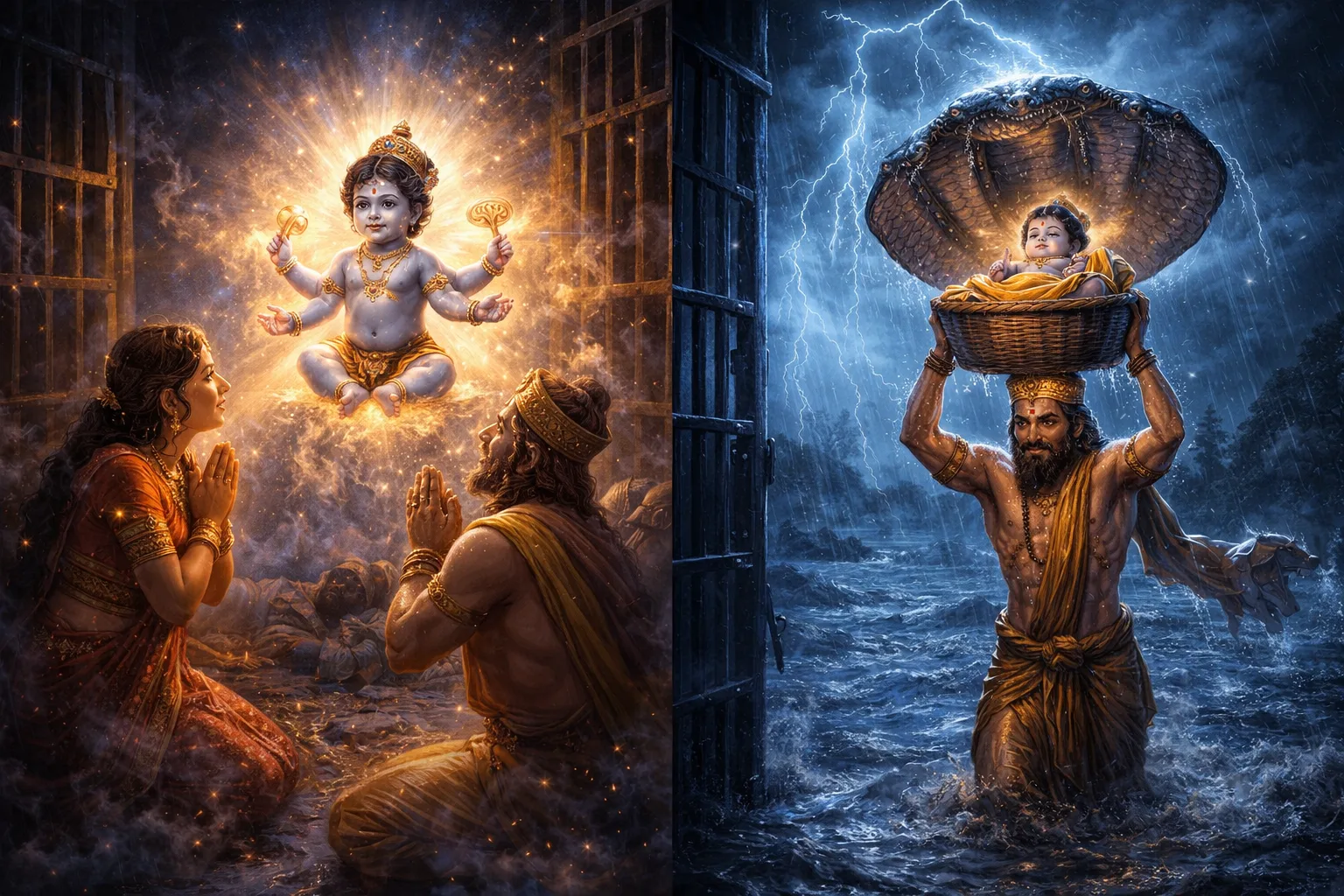
Shri Krishnaji's divine birth in Mathura

Kamsa, the tyrant king of Mathura and son of the demon Kalanemi reborn, had imprisoned his own sister Devaki and her husband Vasudeva on their wedding day after a divine voice from the sky proclaimed that their eighth child would become his destroyer. Six children were born and killed at birth by Kamsa's own hand. The seventh, Balarama, was miraculously transferred to the womb of Rohini in Gokul through Yogamaya's intervention. Then, on the eighth night of the dark fortnight of the month of Bhadra, at the stroke of midnight — the Vijaya muhurta, the most auspicious moment of the year — in a prison cell in Mathura, Devaki's eighth child arrived. He did not arrive as an ordinary infant: he came in the Chaturvyuha form — four-armed, bearing conch, chakra, mace, and lotus, wearing the Kaustubha gem and the Srivatsa mark, crowned with the divine forest garland, his dark body shining with the light of a thousand moons.

He spoke to Devaki and Vasudeva — recognising them and recalling their previous lives together across vast spans of cosmic time. Then he said: "Carry me to Gokul, to the house of Nanda and Yashoda. Exchange me for the girl child that Yashoda has just delivered. Return here before dawn." The moment he finished speaking, he transformed into an ordinary newborn and the divine radiance subsided. At that instant, all the guards fell into magical sleep. The chains binding Vasudeva's wrists fell open of their own accord. The prison doors unlocked themselves and swung wide. Vasudeva lifted his newborn son in a basket and stepped out into the flooded, rain-lashed night. The Yamuna, swelling with monsoon fury, parted when the baby's foot touched the water's surface, making a shallow path.

In Gokul, Vasudeva entered the sleeping house of Nanda — whose wife Yashoda had just given birth — placed Krishnaji gently in Yashoda's arms, lifted the newborn girl, and made the return journey before dawn. When Kamsa seized the girl to dash her against the prison wall as he had done with the previous six, she slipped from his hands, flew into the sky, revealed herself as the goddess Yogamaya, and declared with a laugh that the one destined to end him was already alive and beyond his reach. Kamsa's terror only deepened. He ordered the massacre of every male infant born in Mathura and the surrounding region on that night — the shadow of his fear spreading destruction in every direction. But the one he sought was already in Gokul, sleeping peacefully in Yashoda's arms, wrapped in her love.

Krishnaji's childhood in Gokul and then Vrindavan — celebrated in the Bhagavata Purana's Dashama Skandha with a depth and tenderness that has no equal in world literature — was a time of extraordinary, deliberate ordinariness. The supreme being chose to be a child: to be fed butter by a woman who did not know who she was feeding, to cry with hunger and need, to be scolded for mischief and laughed at in delight, to play in the dust with other children. This choice — the infinite becoming finite, the eternal becoming temporary, the absolute entering into dependency and vulnerability — is the deepest mystery of the Krishna avatara. Yashoda loved him with a love so natural and total that she once scolded him when he cried, oblivious to the fact that this dark-eyed, butter-thieving child in her lap held the universe in his stomach.

मथुरा के अत्याचारी राजा कंस ने अपनी ही बहन देवकी और उनके पति वसुदेव को उनके विवाह के दिन ही कारागार में डाल दिया था — आकाशवाणी हुई थी कि उनका आठवाँ पुत्र कंस का वध करेगा। छह पुत्र जन्म लेते ही कंस के अपने हाथों मारे गए। सातवें, बलराम को, योगमाया के हस्तक्षेप से गोकुल में रोहिणी की कोख में स्थानांतरित किया गया। फिर भाद्रपद कृष्ण अष्टमी की रात के मध्य — विजय मुहूर्त, वर्ष के सबसे शुभ क्षण में — मथुरा की उस कारागार की कोठरी में देवकी का आठवाँ पुत्र आया। वह साधारण शिशु नहीं था: वह चतुर्भुज रूप में आया — शंख, चक्र, गदा और कमल धारण किए, कौस्तुभ मणि और श्रीवत्स चिह्न से युक्त, वनमाला पहने, उनका श्याम वर्ण हजारों चंद्रमाओं के प्रकाश से दीप्त था।

उन्होंने देवकी और वसुदेव से बात की — उन्हें पहचाना और अनंत काल में उनके साथ के पिछले जन्म याद किए। फिर कहा: "मुझे गोकुल ले जाओ, नंद और यशोदा के घर। यशोदा ने अभी एक कन्या को जन्म दिया है — मुझे वहाँ रखो और उस कन्या को यहाँ ले आओ।" उसी क्षण सब पहरेदार जादुई नींद में सो गए। वसुदेव की बेड़ियाँ स्वतः खुल गईं। कारागार के दरवाजे अपने आप खुल गए। वसुदेव अपने नवजात पुत्र को टोकरी में उठाकर उफनती, बारिश से भरी रात में निकल पड़े। जब शिशु के पाँव ने यमुना का जल छुआ, यमुना ने एक उथला मार्ग दे दिया।

गोकुल में, वसुदेव नंद के सोते घर में प्रवेश किए — जिनकी पत्नी यशोदा ने अभी-अभी जन्म दिया था — श्रीकृष्ण को यशोदा की गोद में रखा, उस नवजात कन्या को उठाया और भोर से पहले वापस लौट आए। जब कंस ने उस कन्या को दीवार पर पटकना चाहा, वह उसके हाथ से छूट गई, आकाश में उड़ गई, देवी योगमाया के रूप में प्रकट हुई और हँसते हुए बोली कि जो उसे नष्ट करने वाला है वह पहले से ही जीवित है और उसकी पहुँच से परे है।

गोकुल और वृंदावन में श्रीकृष्ण का बचपन — जिसे भागवत पुराण के दशम स्कंध ने जिस गहराई और कोमलता के साथ वर्णित किया है वह विश्व साहित्य में अनुपम है — एक जानबूझकर सामान्यता का काल था। परम सत्ता ने बालक बनना चुना: एक ऐसी स्त्री द्वारा खिलाया जाना जो नहीं जानती थी कि वह किसे खिला रही है, भूख से रोना, शरारत पर डाँट खाना, अन्य बच्चों के साथ धूल में खेलना। यशोदा ने उनसे उस प्रेम से प्रेम किया जो इतना स्वाभाविक और पूर्ण था कि एक बार उन्होंने उन्हें डाँटा — इस तथ्य से अनजान कि जो काले आँखों वाला, मक्खन चुराने वाला बालक उनकी गोद में था, उसके पेट में ब्रह्मांड था।

Significance  ·  महत्व
This is the origin of Janmashtami — the most celebrated birthday in Hinduism. The miraculous circumstances of the birth establish that Krishnaji came not as an ordinary child but as the supreme consciousness itself, choosing birth to restore dharma and demonstrate that divine love takes any form to reach those who need it.

कृष्ण जन्म की कथा यह सिखाती है कि जब अधर्म चरम पर होता है, तब ईश्वर स्वयं मानव रूप में अवतरित होते हैं। यमुना का रास्ता देना, बेड़ियों का खुलना — यह प्रकृति भी ईश्वरीय लीला में सहभागी होती है। जन्माष्टमी की रात का उत्सव इसी दिव्य घटना का स्मरण है — अंधेरी रात में प्रकाश का जन्म।
Primary Source
Srimad Bhagavata Puran, Skandha 10, Adhyaya 1–3; also Vishnu Puran, Book 5, Chapter 1–3
Story 2 of 5  ·  कथा २ / 5
📖 Srimad Bhagavata Puran · Skandha 10, Adhyaya 24–26

Govardhan Parvat — Krishnaji Lifts the Mountain

गोवर्धन पर्वत — श्री कृष्णजी ने पर्वत उठाया

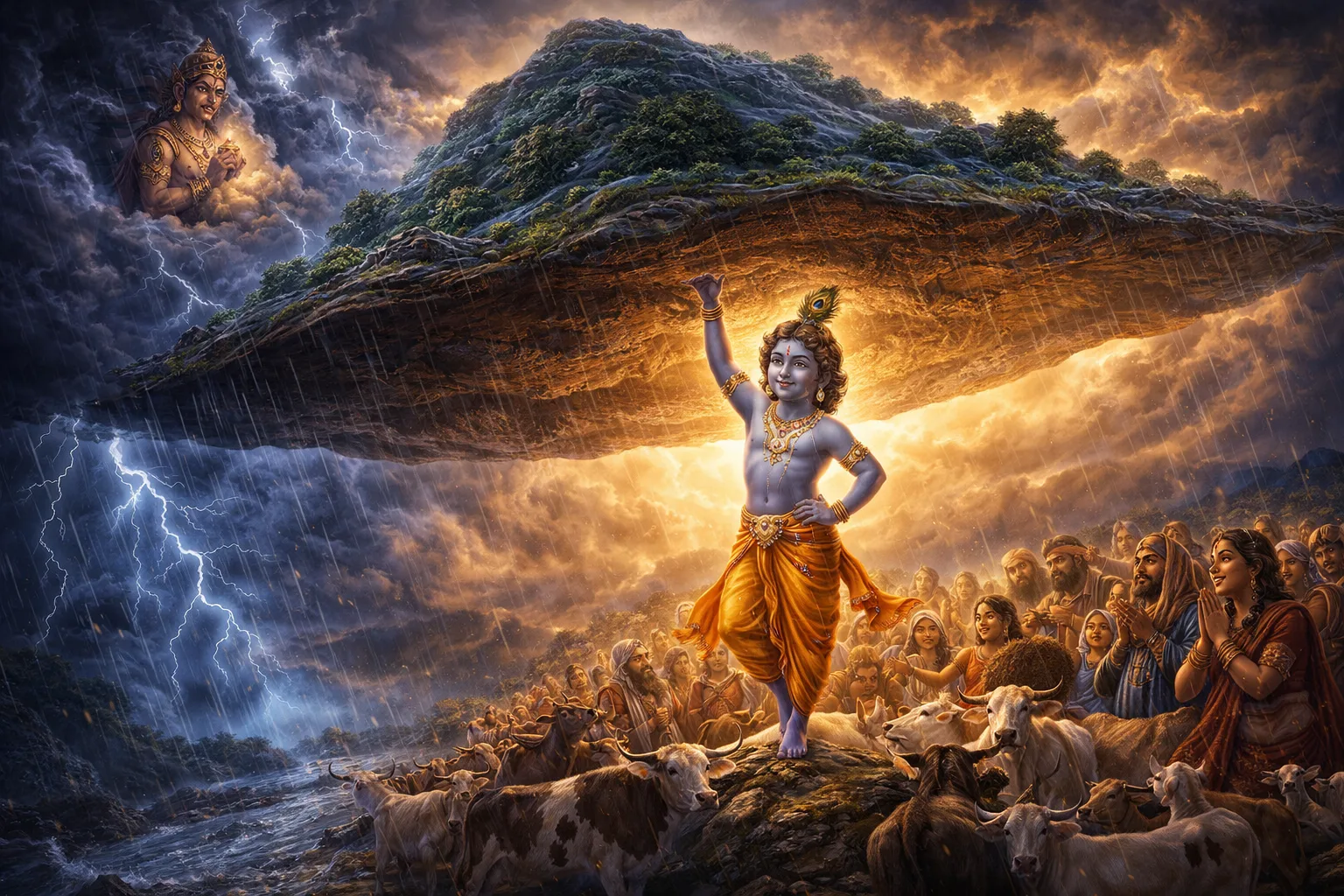
Krishnaji lifting Govardhan Parvat

Every year, the cowherds of Vrindavan performed a great collective worship of Indra — the king of gods and lord of rains — with elaborate offerings, hoping to secure good rainfall for their crops and pastures. It was a tradition built on fear as much as devotion: Indra was powerful, and his displeasure meant drought. Young Krishnaji, perhaps ten years old at the time, sat with his father Nanda and gently, persistently questioned the reasoning: "Why do we worship Indra? We are cowherds. We live by our cows, our forests, our land. Mount Govardhan gives us shade, fodder, and fresh water. Our dharma is to honour what actually sustains us, not to propitiate a distant king out of fear." Nanda and the elders listened, debated, and ultimately agreed. The offerings were redirected to Govardhan Parvat with great celebration.

Indra's reaction was precisely what one might expect of a being whose ego had not yet been tempered by genuine wisdom: he was furious. He unleashed the Samvartaka clouds — the clouds of dissolution, which appear only at the end of a cosmic age — over Vrindavan. For seven days and seven nights, rain fell with an apocalyptic force that threatened to drown the entire region. The Yamuna rose in fury, the land became a sea, and every creature — cow, calf, child, elder — ran for higher ground in terror. Krishnaji watched all this with a serene calm that was itself a statement. He walked to Mount Govardhan, placed the tip of his little finger under its base, and with one effortless motion lifted the entire mountain above his head like an enormous umbrella.

"Come," he said. And every person, every cow, every creature in Vrindavan walked under the shelter of the mountain and was safe. For seven days Krishnaji held the mountain aloft without shifting his weight or showing any strain — a child holding a mountain on one finger while an age of rain fell on the other side. On the seventh day, Indra's pride broke entirely. He understood what he was dealing with. He called off the rains, descended from his heaven, prostrated before Krishnaji — the child who had just humiliated the king of gods in front of the entire universe — and acknowledged him as the supreme being. He performed the Abhisheka of Krishnaji with the celestial waters from his own Airavata elephant, and from that day Krishnaji received the additional name Govinda — the protector of cows, the one honoured by the lord of heaven.

The Govardhan Lila is celebrated to this day on the day after Diwali as Govardhan Puja — an annual remembering of the moment when the divine child taught the three worlds that true protection comes not from fear of the powerful but from the love of the one who holds everything lightly on a single finger. Govardhan Hill in Braj is still circumambulated by pilgrims in bare feet, the devotees performing its parikrama in an act of living memory — the twenty-one kilometre walk around the hill that Krishnaji lifted. The Bhagavata Purana narrates this episode in Skandha 10, Adhyaya 24 to 27, and it remains one of the most beloved and frequently depicted scenes in all of Krishna iconography, sculpture, and classical painting across the centuries.

वृंदावन के गोपाल प्रतिवर्ष इंद्र की — देवताओं के राजा और वर्षा के स्वामी की — भव्य पूजा करते थे, अच्छी वर्षा की आशा में। यह परंपरा भक्ति जितनी भय पर भी आधारित थी। बालकृष्ण, तब लगभग दस वर्ष के, अपने पिता नंद के पास बैठकर धीरे-धीरे प्रश्न करने लगे: "हम इंद्र की पूजा क्यों करें? हम गोपाल हैं। हम अपनी गायों, अपने वनों, अपनी भूमि से जीते हैं। गोवर्धन पर्वत हमें छाया, चारा और जल देता है। हमारा धर्म है कि जो सच में हमारा पोषण करता है उसका सम्मान करें, किसी दूरस्थ राजा की भय से नहीं।" नंद और बुजुर्गों ने विचार-विमर्श किया और अंततः सहमत हुए।

इंद्र की प्रतिक्रिया ठीक वैसी ही थी जो किसी ऐसे प्राणी से अपेक्षित होती जिसका अहंकार अभी तक ज्ञान से परिपक्व नहीं हुआ हो: वे क्रुद्ध हो गए। उन्होंने संवर्तक मेघों को — जो प्रलयकाल में ही आते हैं — वृंदावन पर भेज दिया। सात दिन-रात प्रलयकारी वर्षा हुई जिसने पूरे क्षेत्र को डुबोने की धमकी दी। श्रीकृष्ण ने यह सब शांत भाव से देखा। वे गोवर्धन पर्वत के पास गए, अपनी छोटी कनिष्ठिका की नोक उसके नीचे रखी और सहज भाव से पूरे पर्वत को अपने सिर के ऊपर उठा लिया — एक विशाल छतरी की तरह।

"आओ," उन्होंने कहा। और वृंदावन का हर प्राणी — गाय, बछड़ा, बालक, वृद्ध — पर्वत की छत्रछाया में आ गया और सुरक्षित रहा। सात दिन श्रीकृष्ण ने पर्वत को थामे रखा — बिना थके, बिना किसी कठिनाई के — एक बालक जो एक उँगली पर पर्वत थामे बैठा रहा जबकि एक युग की वर्षा दूसरी ओर बरसती रही। सातवें दिन इंद्र का अहंकार पूर्णतः टूट गया। उन्होंने वर्षा रोकी, स्वर्ग से उतरे, श्रीकृष्ण के सामने नतमस्तक हुए और उन्हें परम सत्ता के रूप में स्वीकार किया।

गोवर्धन लीला आज भी दीपावली के अगले दिन गोवर्धन पूजा के रूप में मनाई जाती है — उस क्षण की स्मृति जब दिव्य बालक ने तीनों लोकों को सिखाया कि सच्ची सुरक्षा शक्तिशाली के भय से नहीं बल्कि उसके प्रेम से आती है जो एक उँगली पर सब कुछ हल्के भाव से थामे रहता है।

Significance  ·  महत्व
This story teaches that the true source of protection is consciousness itself — not any deity driven by ego. It also teaches that gratitude belongs to what actually nourishes us: the earth, the mountain, the rain. Krishnaji's act prefigures the Gita's central teaching: surrender to the eternal principle behind all, not to ego-bound forces.

गोवर्धन लीला का संदेश है कि प्रकृति की सेवा ईश्वर की सेवा है। जो हमें जीवन देता है उसकी कृतज्ञता करनी चाहिए। कृष्ण ने इंद्र के अहंकार को तोड़ा और यह सिखाया कि बल और पद का दुरुपयोग नहीं होना चाहिए। गोवर्धन पूजा आज भी दीपावली के अगले दिन मनाई जाती है।

Primary Source
Srimad Bhagavata Puran, Skandha 10, Adhyaya 24–26 (गोवर्धन-लीला)
Story 3 of 5  ·  कथा ३ / 5
📖 Srimad Bhagavata Puran · Skandha 10, Adhyaya 29–33 (Rasa Panchadhyayi)

The Rasa Lila — The Divine Dance

रास लीला — दिव्य नृत्य

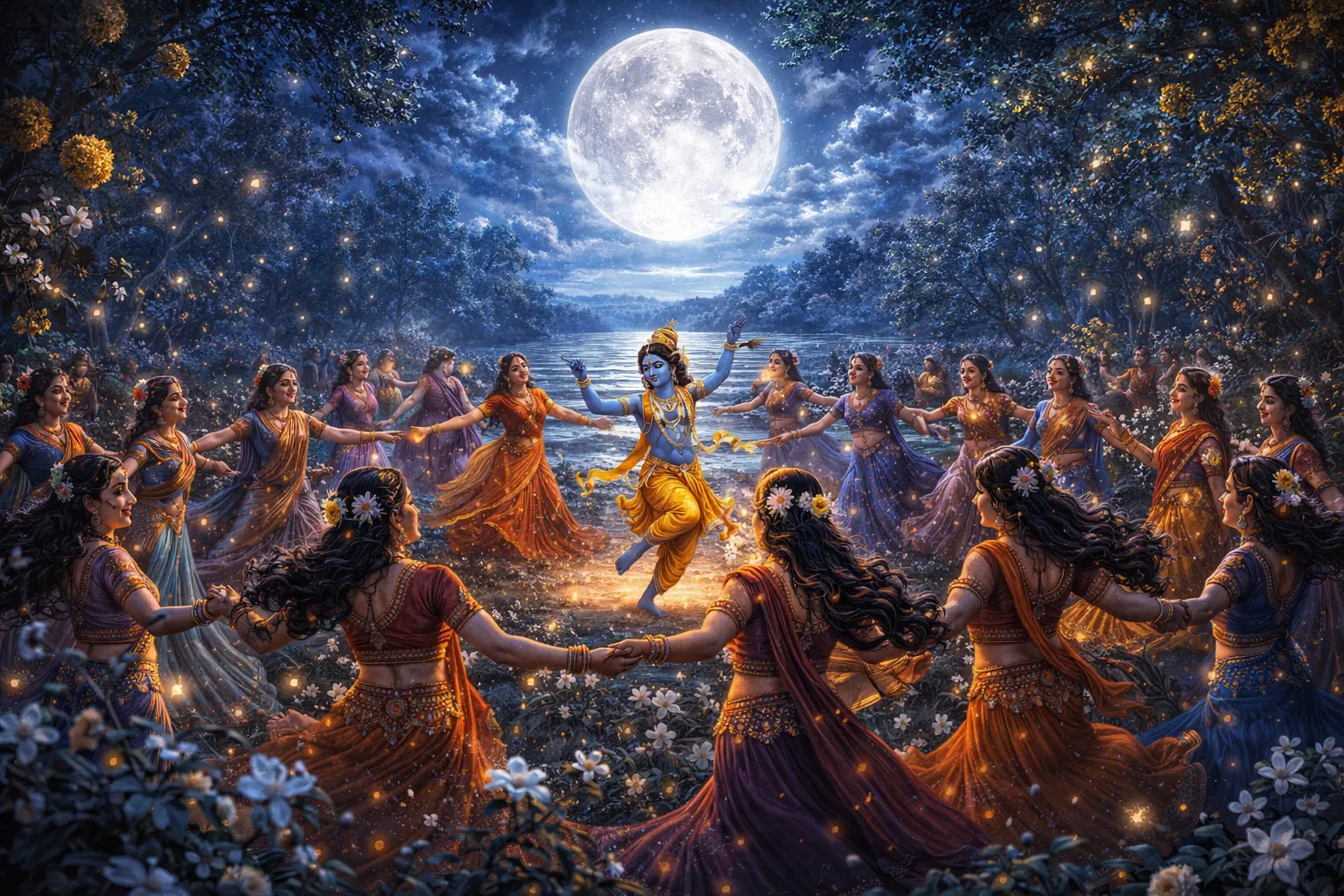
The Rasa Lila — Krishnaji's divine dance

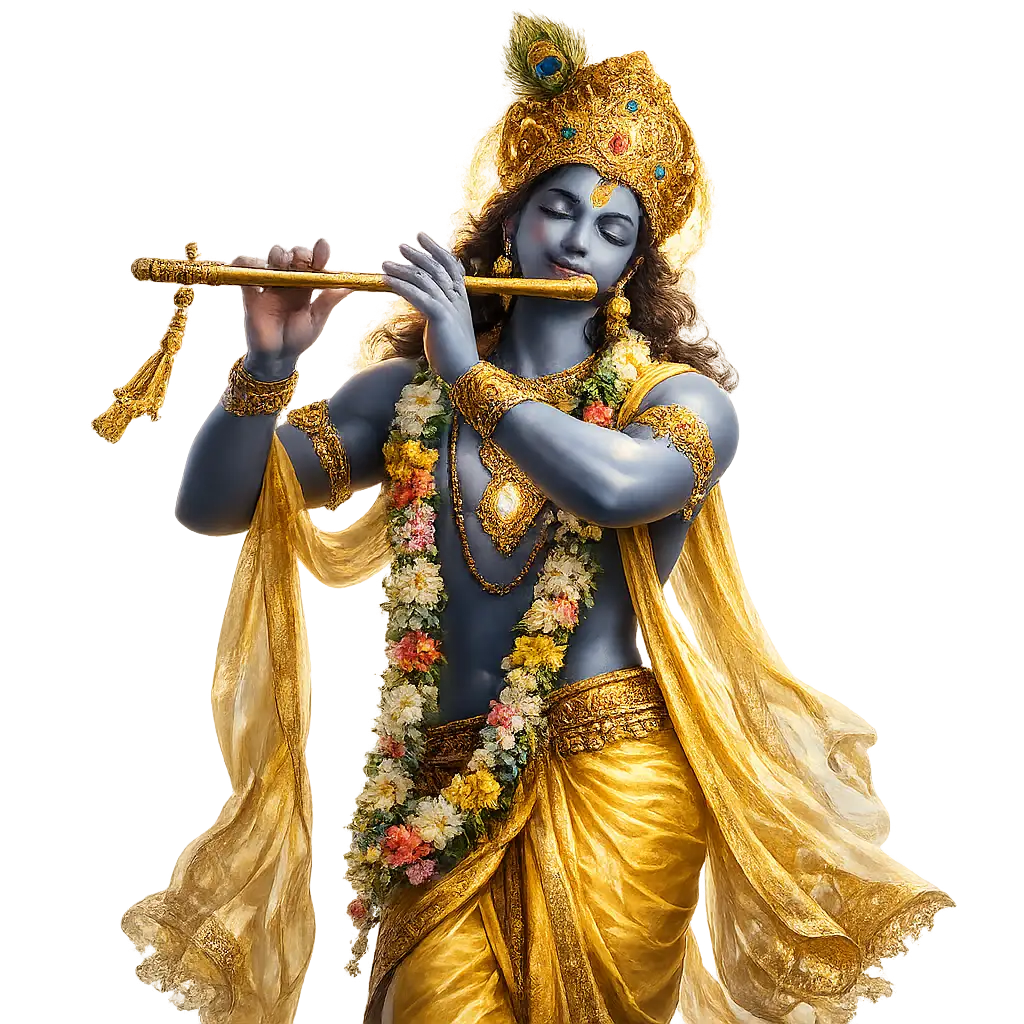
On a full-moon night in the month of Kartika in Vrindavan — the sharad purnima, the most luminous night of the autumn — Krishnaji stood by the Yamuna and put his bamboo bansuri to his lips. What came out was not simply music: it was a call that penetrated walls, sleep, habit, duty, and the thousand small prisons in which ordinary consciousness lives. The gopis — the cowherd women of Vrindavan who had loved Krishnaji from childhood as their dearest companion and who had been growing in a devotion they could not name — heard the sound and were overwhelmed. They left whatever they were doing: cooking, sleeping, nursing infants, speaking to husbands. They did not plan to leave. They simply found themselves walking toward the sound, irresistibly, the way a river finds its way to the sea.

When they arrived at the banks of the Yamuna in the moonlight and found Krishnaji waiting, what followed was the Maharas — the great circle dance. Krishnaji multiplied himself through his divine yoga maya so that each gopi experienced him dancing beside her alone, his full attention entirely on her, her hand in his. The dance moved in an enormous circle under the full moon, the Yamuna flowing silver beside them, the kadamba trees in flower, the night air carrying jasmine. The Bhagavata Purana dedicates five entire chapters to this single night — the Rasa Panchadhyayi — and Shri Shuka, narrating it to King Parikshit, pauses before it with visible reverence, warning that the event cannot be understood through the ordinary categories of desire and possession.

The theology of the Rasa Lila is among the most subtle and beautiful in all of Hindu thought: the gopis' love for Krishnaji is the model of para bhakti — the highest devotion — precisely because it is total, unconditional, and without the mediation of ritual, caste, gender, or social position. Many of the gopis were married women; yet the Bhagavata insists that their love was utterly pure, because it was directed not at a man but at the supreme reality that had taken the form of a man. To love Krishnaji in this way was to love the ground of being itself — and the Rasa Lila is the meeting of individual consciousness with universal consciousness in a moment of complete union. The dance continued through the night — a night the Bhagavata says lasted a complete brahmic kalpa from the perspective of the gopis, though in worldly time it was a single night.

The Rasa Lila is the subject of the Gita Govinda of Jayadeva, the compositions of Mirabai, the paintings of Pahari and Rajput masters, the poetry of Surdas and Nandadasa, and countless devotional traditions across centuries. In the Krishna Bhakti tradition it is considered the pinnacle expression of divine love — the moment when the supreme being demonstrates that he is not merely to be feared, obeyed, or even worshipped from a distance, but loved with the totality of one's being, as intimately and completely as it is possible for a finite creature to love. The Bhagavata says: "He who hears this sacred account of the Maharas with faith and devotion shall attain the highest devotion to Vasudeva and shall swiftly conquer the disease of the heart that is lust." The Rasa Lila is narrated in the Srimad Bhagavata Purana, Skandha 10, Adhyaya 29 to 33.

कार्तिक माह की पूर्णिमा की रात वृंदावन में — शरद पूर्णिमा, शरद की सबसे प्रकाशमान रात — श्रीकृष्ण यमुना के किनारे खड़े हुए और अपनी बाँसुरी होठों से लगाई। जो निकला वह केवल संगीत नहीं था: यह एक ऐसी पुकार थी जो दीवारों, नींद, आदत, कर्तव्य और उन हजारों छोटी-छोटी कारागारों को भेद गई जिनमें साधारण चेतना जीती है। गोपियाँ — वृंदावन की गोपी महिलाएं जो बचपन से कृष्ण से प्रेम करती थीं और जिनकी भक्ति बढ़ती जा रही थी जिसे वे नाम भी नहीं दे पाती थीं — वह ध्वनि सुनकर अभिभूत हो गईं। वे जो कर रही थीं वह छोड़ दिया — खाना बनाना, सोना, शिशु को दूध पिलाना, पति से बात करना — और उस आवाज़ की ओर चल पड़ीं, जैसे नदी समुद्र की ओर जाती है।

जब वे पूर्णिमा के प्रकाश में यमुना के किनारे पहुँचीं और श्रीकृष्ण को वहाँ पाया, जो हुआ वह महारास था — महान वृत्ताकार नृत्य। श्रीकृष्ण ने अपनी दिव्य योगमाया से स्वयं को इस तरह विस्तारित किया कि हर गोपी को अनुभव हुआ कि वे केवल उसके साथ नृत्य कर रहे हैं, उनका सम्पूर्ण ध्यान केवल उस पर। नृत्य पूर्ण चंद्रमा के नीचे एक विशाल वृत्त में घूमा। भागवत पुराण इस एक रात को पाँच पूरे अध्यायों में वर्णित करता है — रास पंचाध्यायी।

रास लीला का दर्शन हिंदू विचार में सबसे सूक्ष्म और सुंदर है: गोपियों का श्रीकृष्ण के प्रति प्रेम परा भक्ति का आदर्श है — उच्चतम भक्ति — ठीक इसलिए क्योंकि वह पूर्ण, बिना शर्त, और अनुष्ठान, जाति, लिंग या सामाजिक स्थिति की मध्यस्थता के बिना है। इस प्रकार श्रीकृष्ण से प्रेम करना परम वास्तविकता से ही प्रेम करना था — और रास लीला व्यक्तिगत चेतना का सार्वभौमिक चेतना से पूर्ण मिलन है।

रास लीला जयदेव के गीत गोविंद, मीराबाई की रचनाओं, सूरदास और नंददास की कविताओं, और सदियों में असंख्य भक्ति परंपराओं का विषय रही है। कृष्ण भक्ति परंपरा में यह दिव्य प्रेम की सर्वोच्च अभिव्यक्ति मानी जाती है।

Significance  ·  महत्व
The Rasa Lila is the centrepiece of the Bhagavata's philosophy of prema-bhakti. The gopis' love is the ideal of devotion because it was utterly selfless — they sought nothing in return, not even liberation. Their surrender was complete. This is why the Bhagavata says even great meditating sages can learn from the gopis.

रास लीला भक्ति की उच्चतम अवस्था का प्रतीक है — जहां भक्त का सारा अस्तित्व ईश्वर में समर्पित हो जाता है। यह सांसारिक प्रेम का चित्रण नहीं, बल्कि आत्मा और परमात्मा के मिलन का दिव्य रूपक है। राधा का कृष्ण-प्रेम सर्वोच्च भक्ति का प्रतीक है — निर्लिप्त, निःस्वार्थ, अनंत।

Primary Source
Srimad Bhagavata Puran, Skandha 10, Adhyaya 29–33 (रास पंचाध्यायी)
Story 4 of 5  ·  कथा ४ / 5
📖 Mahabharat · Bhishma Parva (Bhagavad Gita — 18 chapters)

The Bhagavad Gita — Krishnaji's Teaching on the Battlefield

भगवद्गीता — कुरुक्षेत्र में श्री कृष्णजी का उपदेश

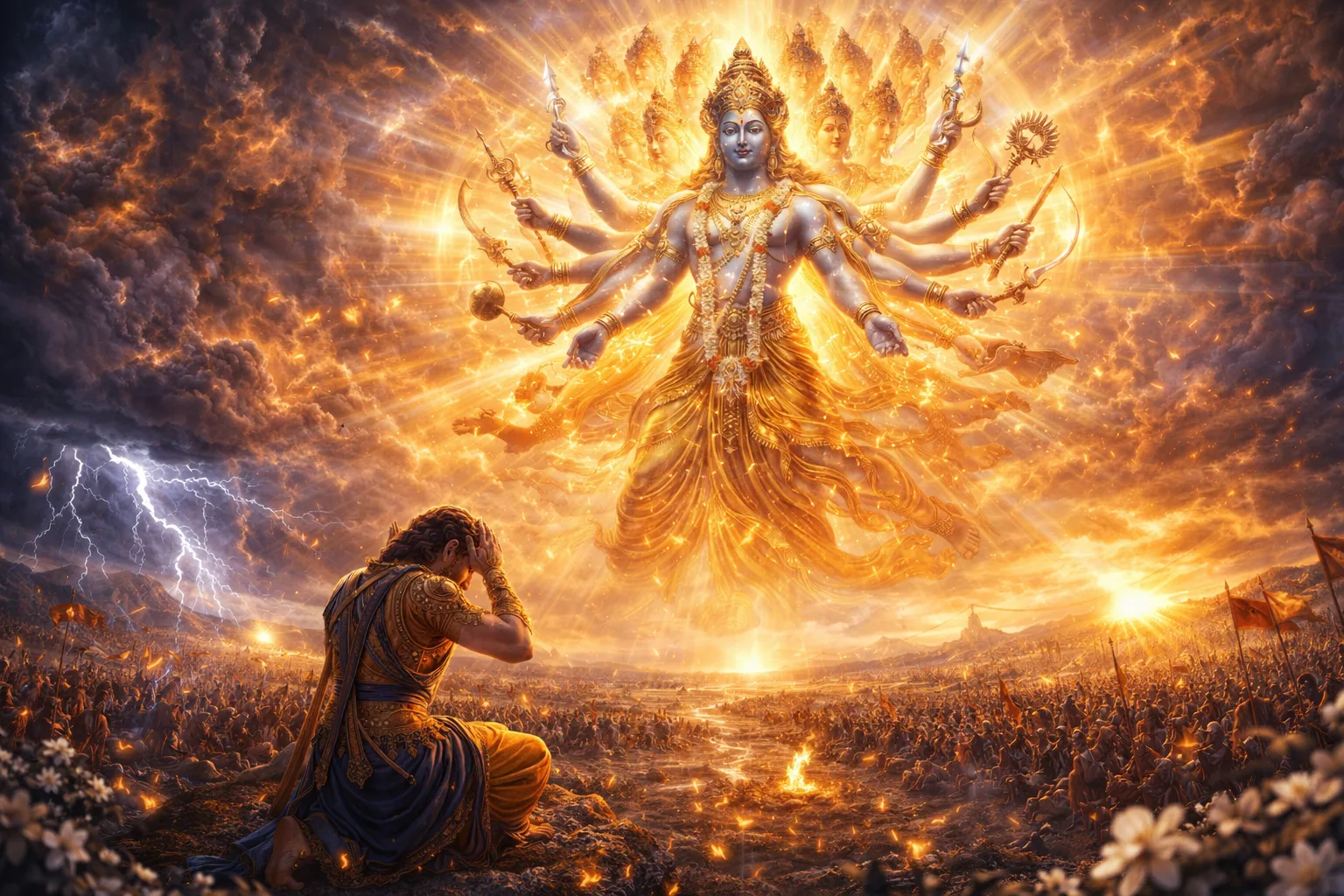
Krishnaji delivering the Bhagavad Gita on the battlefield

When Arjuna asked Krishnaji to drive his chariot to the centre of the battlefield of Kurukshetra so he could see who stood arrayed against the Pandavas, he was a warrior at the height of his powers — the greatest archer alive, trained by Drona, holder of the Gandiva, a man who had never flinched before any battle. But what he saw from that chariot changed everything: on the other side, in neat and terrible arrays, stood his grandfather Bhishma, his teacher Drona, his cousins the Kauravas — all the people who had defined his world, who had made him who he was, who would now have to die by his hand or kill him. His bow slipped from his fingers. He collapsed onto the seat of the chariot. He said: "I cannot fight. I will not fight. What dharma is this, that I must kill my own family?"

Krishnaji did not console him. He did not say it would be easy or that the grief was wrong. He began to teach — and what came from him in the next eighteen chapters of the Bhagavad Gita is the most compressed and complete expression of philosophical and spiritual truth in any human language. He began with the distinction between the body and the atman (soul): the body is born, ages, and dies; the atman — the pure awareness that inhabits the body — was never born and can never die. "Nainam chhindanti shastrani" — no weapon can cut it; fire cannot burn it; water cannot wet it; wind cannot dry it. Grief over what cannot die is therefore a fundamental confusion about reality. He spoke of swadharma — one's own righteous duty, which for a Kshatriya in a righteous war cannot be abandoned without the deepest spiritual cost.

He described the four yogas as four different entry points into the same ultimate reality: Jnana yoga, the path of knowledge and discriminating wisdom; Bhakti yoga, the path of love and surrender to the divine; Karma yoga, the path of selfless action performed without attachment to its fruits; and Dhyana yoga, the path of meditation and inner stillness. He spoke of the three gunas — sattva, rajas, tamas — the three fundamental qualities of nature that colour all of existence and all action. He described the supreme Purusha who stands beyond the gunas, beyond the field of experience, beyond even the highest state of nature. And then, in the eleventh chapter — the Vishwarupa Darshana — he granted Arjuna divine vision and revealed his universal form: all of creation, all destruction, all gods, all time, all worlds, all beings existing simultaneously within him, the cosmic mouth consuming everything.

Arjuna, overwhelmed and terrified by the Vishwarupa, asked Krishnaji to return to his familiar, beloved human form. And Krishnaji did — quietly, gently — and spoke the final verses of the Gita: "Abandon all dharmas. Take refuge in me alone. I will liberate you from all sins. Do not grieve." These two lines — the Charama Shloka, the final verse — are considered by many commentators the entire meaning of the Gita compressed to its essence: not a set of rules or a system to master, but an invitation to complete surrender to the divine, which is simultaneously the most difficult and the most natural thing a human being can do. Arjuna rose, picked up his bow, and fought. The Gita has been commented upon by Adi Shankaracharya, Ramanujacharya, Madhvacharya, Tilak, Gandhi, and Sri Aurobindo, and has been called by Aldous Huxley and others the most complete single philosophical text in human history.

जब अर्जुन ने श्रीकृष्ण से कहा कि वे रथ को कुरुक्षेत्र के युद्धक्षेत्र के केंद्र में ले जाएं, वे अपनी शक्ति के चरम पर एक योद्धा थे। किंतु रथ से जो उन्होंने देखा उसने सब कुछ बदल दिया: दूसरी ओर पितामह भीष्म, गुरु द्रोण, अपने सभी कौरव भाई — वे सब लोग खड़े थे जिन्होंने उनकी दुनिया बनाई थी। उनका धनुष उँगलियों से फिसल गया। वे रथ पर बैठ गए। बोले: "मैं नहीं लड़ सकता।"

श्रीकृष्ण ने उन्हें सांत्वना नहीं दी। वे सिखाने लगे — और जो उनसे अगले अठारह अध्यायों में निकला वह भगवद्गीता है: किसी भी मानव भाषा में दार्शनिक और आध्यात्मिक सत्य की सबसे संक्षिप्त और सम्पूर्ण अभिव्यक्ति। उन्होंने शरीर और आत्मा के भेद से आरंभ किया: "नैनं छिंदंति शस्त्राणि" — कोई शस्त्र आत्मा को नहीं काट सकता, अग्नि जला नहीं सकती, जल भिगो नहीं सकता, वायु सुखा नहीं सकती। उन्होंने स्वधर्म के बारे में बताया — अपना धार्मिक कर्तव्य जिसे बिना गहरे आध्यात्मिक मूल्य के भुनाया नहीं जा सकता।

उन्होंने चार योगों का वर्णन किया: ज्ञान योग, भक्ति योग, कर्म योग और ध्यान योग — सभी एक ही परम वास्तविकता के अलग-अलग प्रवेश द्वार। फिर ग्यारहवें अध्याय में — विश्वरूप दर्शन — उन्होंने अर्जुन को दिव्य दृष्टि दी और अपना विश्वरूप दिखाया: समस्त सृष्टि, समस्त विनाश, सभी देव, सम्पूर्ण काल, सभी लोक — सब कुछ एक साथ उनमें विद्यमान। अर्जुन अभिभूत और भयभीत हो गए और उन्होंने परिचित रूप माँगा।

श्रीकृष्ण शांत भाव से लौटे और गीता के अंतिम श्लोक बोले: "सर्व धर्मान परित्यज्य मामेकं शरणं व्रज।" — यह गीता का सार है। अर्जुन उठे, धनुष उठाया और लड़े। गीता पर आदि शंकराचार्य, रामानुजाचार्य, मध्वाचार्य, तिलक और गांधी ने टीका लिखी है — और इसे मानव इतिहास के सबसे सम्पूर्ण दार्शनिक ग्रंथों में से एक कहा जाता है।

Significance  ·  महत्व
The Bhagavad Gita is one of the most influential philosophical texts in human history — still guiding hundreds of millions of lives. It is not only a religious text but a complete manual of living: how to face grief, how to act under pressure, how to relate to mortality, and how to find the divine in every ordinary moment.

भगवद्गीता मानव जीवन के हर संकट का उत्तर है। जब हम अपने कर्तव्य से विमुख होते हैं, तब कृष्ण की यह वाणी हमें पुनः मार्ग दिखाती है। "निष्काम कर्म" — फल की इच्छा बिना कर्म — यह जीवन का सर्वोच्च सिद्धांत है। विश्वरूप दर्शन यह बताता है कि ईश्वर ही काल हैं, और उनकी योजना में सब कुछ निहित है।

Primary Source
Mahabharat, Bhishma Parva, Adhyaya 23–40 (Bhagavad Gita); also published independently
Story 5 of 5  ·  कथा ५ / 5
📖 Srimad Bhagavata Puran · Skandha 10, Adhyaya 43–44

Krishnaji Ends Kamsa — Dharma is Restored

कंस वध — धर्म की पुनर्स्थापना

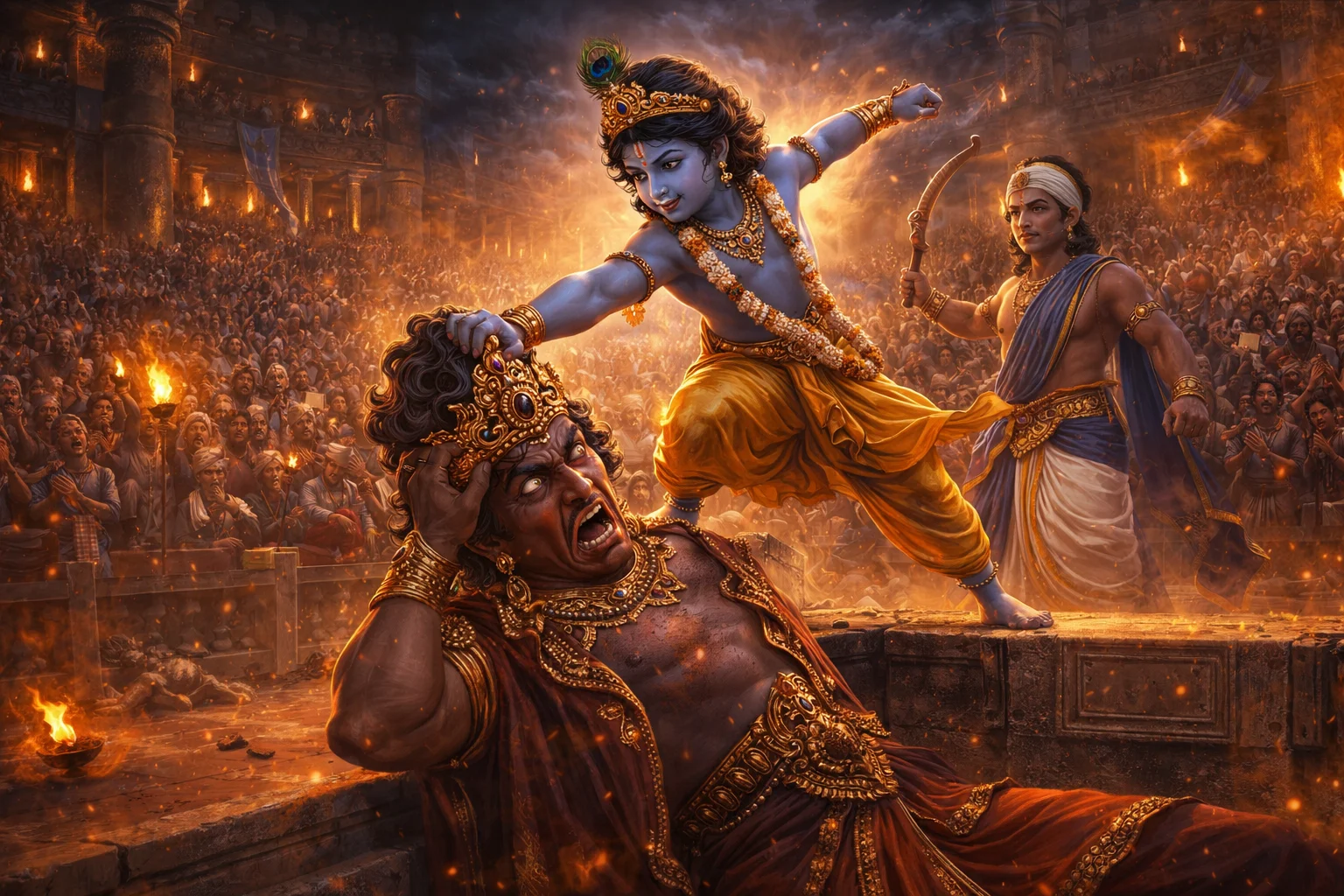
Krishnaji ending Kamsa's tyranny

When Krishnaji and Balarama were still adolescents in Vrindavan — though Krishnaji had already slain Putana, Trinavarta, Bakasura, Aghasura, and the great serpent Kaliya from the Yamuna — Kamsa in Mathura, increasingly desperate and receiving reports of each demon's death, changed his approach. He invited the two brothers to Mathura under the pretence of a wrestling tournament and the Dhanur Yajna festival, intending to have them killed in the arena by his champion wrestlers Chanura and Mushtika, and if that failed, by the maddened elephant Kuvalayapida waiting at the arena gates. The invitation was brought to Nanda by Akrura, one of Kamsa's nobles who was secretly a devotee of Krishnaji and wept during the entire journey to Gokul at the mission he had been given.

The farewell of Krishnaji from Vrindavan is one of the most emotionally devastating passages in the entire Bhagavata: the gopis lining the road, the cows following the chariot, the dust of Vrindavan settling on Krishnaji's departing form, Radha standing still and watching until the chariot was gone from sight and the dust of the road had settled. Krishnaji turned and looked back once — only once — and that single backward glance is the subject of ten thousand poems and paintings in the Braj tradition. He never returned to Vrindavan to live. The boy of Vrindavan became, in Mathura and Dwarka, a king, a statesman, and the charioteer of the Mahabharata. But every tradition insists that his heart never left Vrindavan, and that those who know how to look can still find him there.

In Mathura, Krishnaji and Balarama dispatched Kuvalayapida at the arena gates with casual, almost playful efficiency — tearing out the elephant's tusks and using them as weapons — and walked into the arena carrying them. The crowd, who had come expecting to watch the young men be slaughtered, stared in stunned silence. Then Chanura and Mushtika, Kamsa's champions — men of extraordinary size and training who had killed opponents in practice bouts — entered the arena. The wrestling match that followed was terrifyingly unequal: enormous, professional killers against two young men who fought with the grace of people for whom effort does not exist. Chanura fell to Krishnaji. Mushtika fell to Balarama. Other wrestlers fell to the brothers' cousins. The crowd, which had been silent in fear, began to roar.

Then Krishnaji turned toward the royal gallery where Kamsa sat, watching in mounting terror as every plan failed. There was a silence in the arena. Krishnaji leapt — a single leap that carried him from the arena floor to the royal platform — seized Kamsa by his crown and his hair, and threw him down to the arena floor. The tyrant who had imprisoned his own sister and killed six of her children met his end. Krishnaji immediately went to the prison, broke the chains of Devaki and Vasudeva, bowed at their feet, and wept as the son who had never been held by his mother now finally stood before her. Devaki and Vasudeva wept, unable to believe what their arms were holding. The city of Mathura, freed from decades of terror, broke into celebration. The Bhagavata records that even Kamsa, slain by Krishnaji's hands, attained liberation — for to be killed by the supreme being, the texts say, is itself a form of grace.

जब श्रीकृष्ण और बलराम किशोरावस्था में वृंदावन में थे — यद्यपि श्रीकृष्ण पूतना, त्रिणावर्त, बकासुर, अघासुर और यमुना के महासर्प कालिया का वध कर चुके थे — कंस ने एक नया षड्यंत्र रचा। उसने दोनों भाइयों को मथुरा में मल्लयुद्ध और धनुर्यज्ञ महोत्सव के बहाने आमंत्रित किया। निमंत्रण अक्रूर ले गए — कंस के एक अमात्य जो गुप्त रूप से श्रीकृष्ण के भक्त थे और पूरी यात्रा आँसू बहाते रहे।

वृंदावन से विदाई भागवत की सर्वाधिक भावपूर्ण घटनाओं में से एक है: रास्ते पर खड़ी गोपियाँ, रथ के पीछे-पीछे चलती गायें, वृंदावन की धूल श्रीकृष्ण के जाते रूप पर बैठती हुई, राधा स्थिर खड़ी देखती रही जब तक रथ दिखाई देना बंद नहीं हो गया। श्रीकृष्ण एक बार पलटकर देखा — बस एक बार — और वह एक दृष्टि ब्रज परंपरा में दस हजार कविताओं और चित्रों का विषय है। वे वृंदावन लौटकर कभी नहीं रहे।

मथुरा में, श्रीकृष्ण और बलराम ने दरवाजे पर प्रतीक्षारत हाथी कुवलयापीड को सहज भाव से पराजित किया — उसके दाँत उखाड़े और उन्हें हथियार बनाया। अखाड़े में पहुँचे। कंस के पहलवान चाणूर और मुष्टिक — असाधारण आकार और प्रशिक्षण के वे योद्धा जो अभ्यास में प्रतिद्वंद्वियों को मार चुके थे — दर्द रहित भाव से पराजित हुए।

तब श्रीकृष्ण ने राजदीर्घिका की ओर देखा जहाँ कंस बढ़ते आतंक के साथ बैठा था। एक छलाँग में वे राजमंच पर पहुँचे, कंस को उसके मुकुट और बालों से पकड़ा और मंच से नीचे पटक दिया। वह अत्याचारी जिसने अपनी बहन के छह बच्चों को मारा था, उसका अंत हुआ। श्रीकृष्ण तत्काल कारागार गए, देवकी और वसुदेव की बेड़ियाँ तोड़ीं, उनके चरणों में नतमस्तक हुए — और वह पुत्र जिसे कभी माँ ने गोद नहीं लिया था, अब पहली बार उनके सामने खड़ा था।

Significance  ·  महत्व
The ending of Kamsa marks the fulfilment of Krishnaji's primary mission: the restoration of dharma by removing what had corrupted it. The reunion of Krishnaji with Devaki and Vasudeva after everything they had suffered is among the most emotionally powerful scenes in Hindu literature — a divine being who chose love and chose to feel.

कंस वध केवल एक अत्याचारी के अंत की कथा नहीं — यह अहंकार पर विनम्रता की, भय पर प्रेम की और अधर्म पर धर्म की विजय है। कृष्ण ने जो किया वह धर्म-रक्षा के लिए था, व्यक्तिगत प्रतिशोध के लिए नहीं। माता-पिता का मिलन — वह भावनात्मक क्षण — दर्शाता है कि ईश्वर व्यक्तिगत संबंधों को भी सम्मान देते हैं।

Primary Source
Srimad Bhagavata Puran, Skandha 10, Adhyaya 43–44 (कंस वध); also Vishnu Puran, Book 5, Chapter 20