🏹 ← Ramji Temple 🏠 Home
📖 Pooja Vidhi 📚 All Kathas
Shri Ramji

Ram Katha

Authentic stories of Shri Ramji from the Valmiki Ramayana
and Ramcharitmanas — from birth to Ramrajya

राम कथा

वाल्मीकि रामायण और रामचरितमानस से
श्री रामजी की प्रामाणिक कथाएं

🏹 श्री रामजी का जन्म और बाल्यकाल — राम नवमी 🌿 श्री रामजी का वनवास — मर्यादा पुरुषोत्तम 🦅 सीता माँ का अपहरण और वन में खोज 🔥 लंका युद्ध और रावण वध — धर्म की विजय 👑 अयोध्या वापसी और रामराज्य
Story 1 of 5  ·  कथा १ / 5
📖 Valmiki Ramayana · Bala Kanda · Also Ramcharitmanas by Tulsidas

The Birth and Early Life of Shri Ramji — Ram Navami

श्री रामजी का जन्म और बाल्यकाल — राम नवमी
Shri Ramji breaking the Pinaka bow at Sita's swayamvara

King Dasharatha of Ayodhya, sovereign of the Ikshvaku dynasty and lord of the solar lineage, had three queens — Kaushalya, Kaikeyi, and Sumitra — but no heir to his vast kingdom. The absence of a son weighed on him as a dharmic failing: a king without a successor leaves his kingdom and his ancestors both unprotected. On the counsel of his royal priest Vasishtha, he performed the Putrakameshti yajna — a sacred fire sacrifice specifically for the boon of sons — conducted by the great sage Rishyashringa. The fire sacrifice was carried out with perfect ritual precision, and from the consecrated fire emerged a luminous being carrying a golden vessel filled with payasam — divine sweet rice. Dasharatha distributed the payasam among his queens as instructed, and the divine grace of the yajna was set in motion.

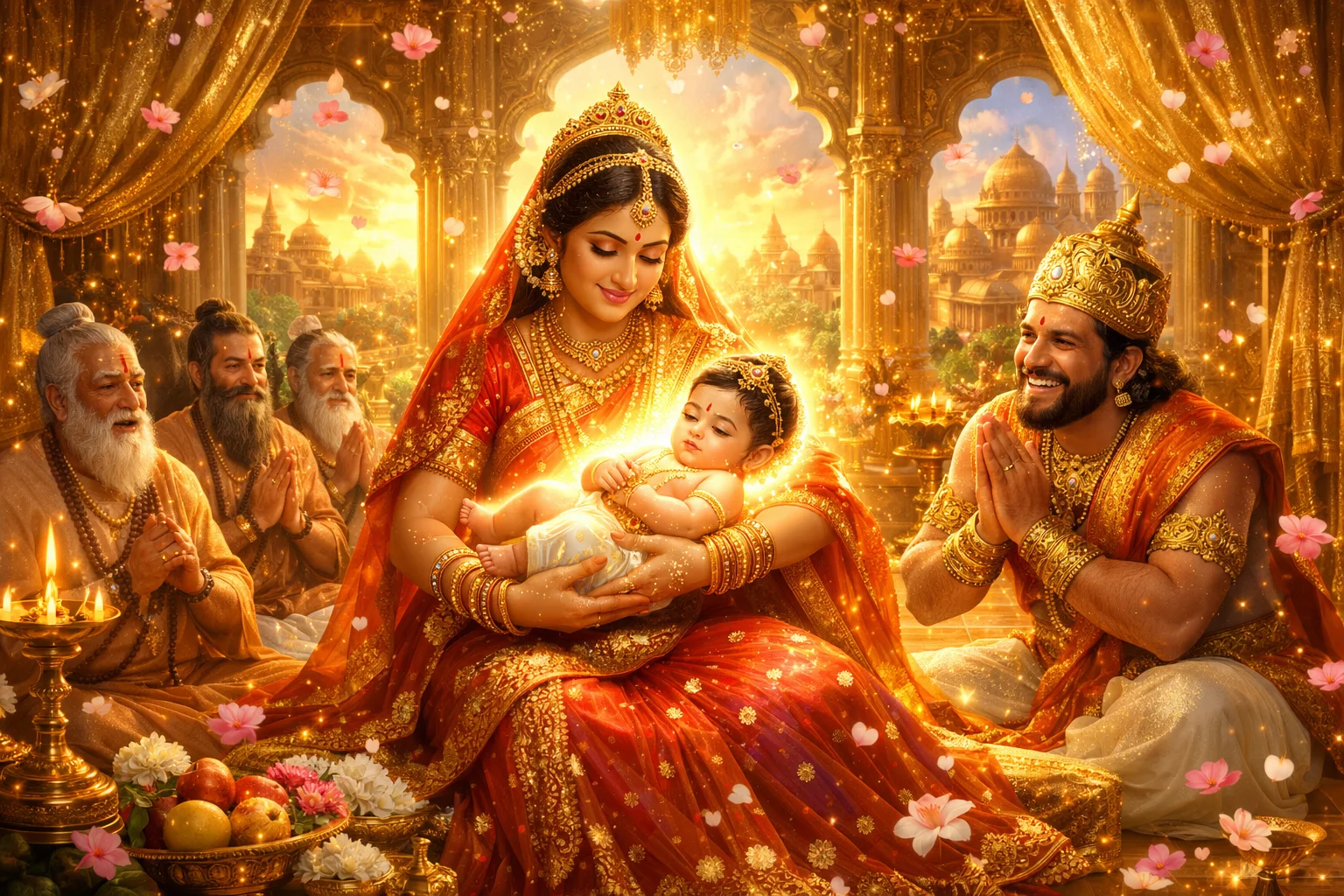
On the ninth day of the bright fortnight of the month of Chaitra — now celebrated as Ram Navami — as the sun rose to its zenith in the sign of Aries in full brilliance, Kaushalya gave birth to the eldest son. He radiated divine light from birth, bore the marks of Vishnu on his body, and the three worlds filled with joy at his arrival as though reality itself recognised what had come among them. Gods showered flowers from the sky over Ayodhya. Sages in distant hermitages looked up from their meditation and smiled without knowing why. The city erupted in celebration. He was named Rama — Ramchandra — Ramji — a name whose sound itself, the ancient texts say, is the essence of the thousand names of Vishnu compressed into two syllables.

Kaikeyi gave birth to Bharata, and Sumitra to the twins Lakshmana and Shatrughna. From childhood the four princes were extraordinary — none more so than Ramji, whose perfection was not in supernatural display but in the quality of his character: his gentleness with every creature, his absolute integrity in word and deed, his effortless embodiment of dharma in every moment. The sage Vishwamitra, recognising his divine nature, came to the court and requested Ramji to protect his yajnas from the demons Maricha and Subahu. Though Dasharatha resisted sending his young son, the sage's authority prevailed. In the forest, Ramji received divine weapons and slew the demons. In Mithila, the young prince strung and broke the mighty Pinaka bow of Shivji at the swayamvara of Sita Devi, daughter of King Janaka — winning her hand in what the Ramayana describes as the most auspicious marriage in creation.

Sita Devi herself was no ordinary being: Janaka had found her as an infant emerging from a furrow in the earth while he was ploughing a field in preparation for a yajna — she was not born of woman but of the earth itself, and Janaka raised her as his own precious daughter. Her union with Ramji was the meeting of Vishnu and Lakshmi in human form — the divine couple reuniting through the mechanism of a mortal life. The Bala Kanda of the Valmiki Ramayana, and Tulsidas's Ramcharitmanas in its Bal Kanda, both narrate this period in exquisite detail — the joy of Ayodhya, the perfection of the four brothers, the divine wedding — establishing from the outset that what is about to unfold is not merely a human story but the descent of the highest reality into the world to demonstrate, through lived example, what dharma truly means.

अयोध्या के राजा दशरथ — इक्ष्वाकु वंश के अधिपति — की तीन रानियाँ थीं — कौशल्या, कैकेयी और सुमित्रा — किंतु कोई उत्तराधिकारी नहीं था। पुरोहित वशिष्ठ के परामर्श पर उन्होंने पुत्रकामेष्टि यज्ञ करवाया — महर्षि ऋष्यशृंग के निर्देशन में। यज्ञाग्नि से एक दिव्य पुरुष प्रकट हुआ जो सोने के पात्र में दिव्य पायसम लेकर आया। दशरथ ने तीनों रानियों में पायसम बाँटा और यज्ञ की दिव्य कृपा गतिशील हुई।

चैत्र मास के शुक्ल पक्ष की नवमी को — अब राम नवमी के रूप में मनाई जाती है — जब सूर्य मेष राशि में अपनी पूर्ण आभा के साथ उच्च पर था, कौशल्या ने ज्येष्ठ पुत्र को जन्म दिया। उनके शरीर पर जन्म से ही दिव्य प्रकाश था, उन पर विष्णु के चिह्न थे। देवताओं ने आकाश से अयोध्या पर पुष्पवर्षा की। दूरस्थ आश्रमों में ऋषि अपनी समाधि से मुस्कुराकर उठे बिना जाने क्यों। नगर उत्सव में फट पड़ा। उनका नाम राम रखा गया — रामचंद्र — रामजी — एक नाम जिसकी ध्वनि प्राचीन ग्रंथों के अनुसार विष्णु के सहस्र नामों का सार है।

कैकेयी ने भरत को जन्म दिया और सुमित्रा ने जुड़वाँ लक्ष्मण और शत्रुघ्न को। बचपन से चारों राजकुमार असाधारण थे — रामजी सबसे विशेष, जिनकी पूर्णता अलौकिक प्रदर्शन में नहीं बल्कि उनके चरित्र की गुणवत्ता में थी: हर प्राणी के प्रति स्नेह, वचन और कर्म में पूर्ण निष्ठा, हर क्षण में धर्म का सहज स्वाभाविक पालन। ऋषि विश्वामित्र उन्हें अपने यज्ञों की रक्षा के लिए ले गए। जनकपुरी में रामजी ने शिवजी के पिनाक धनुष को तोड़कर सीता देवी का हाथ जीता — जो जनक राजा की पुत्री थीं और धरती की कोख से प्रकट हुई थीं।

सीता देवी कोई साधारण प्राणी नहीं थीं: जनक ने उन्हें एक शिशु के रूप में पाया था जब वे यज्ञ की तैयारी में खेत जोत रहे थे — वे किसी स्त्री से नहीं बल्कि धरती से ही जन्मी थीं। रामजी और सीता का मिलन विष्णु और लक्ष्मी का मानव रूप में मिलन था। बाल काण्ड अयोध्या के उत्सव, चारों भाइयों की पूर्णता और दिव्य विवाह का वर्णन करता है — यह स्थापित करते हुए कि जो घटित होने वाला है वह केवल एक मानवीय कहानी नहीं बल्कि सर्वोच्च सत्ता का संसार में अवतरण है ताकि जीवन के उदाहरण से यह दिखाया जा सके कि धर्म का सच्चा अर्थ क्या है।

Significance  ·  महत्व
The birth of Ramji is the origin of Ram Navami — one of the most widely celebrated festivals in Hinduism. His childhood establishes the model of the ideal human being: not one who uses power for personal gain, but one in whom virtue is simply natural — as natural as breathing.

राम जन्म की कथा यह सिखाती है कि ईश्वर तब अवतरित होते हैं जब धरती पर अधर्म बढ़ता है। राम का जन्म राम नवमी को मनाया जाता है — यह उत्सव मर्यादा, प्रेम और धर्म के अवतरण का उत्सव है। राम की जीवन-गाथा केवल एक राजकुमार की कहानी नहीं — यह आदर्श पुरुषार्थ का दर्पण है।
Primary Source
Valmiki Ramayana, Bala Kanda, Sarga 1–77; Ramcharitmanas, Bala Kanda by Tulsidas
Story 2 of 5  ·  कथा २ / 5
📖 Valmiki Ramayana · Ayodhya Kanda

The Exile of Shri Ramji — Maryada Purushottam

श्री रामजी का वनवास — मर्यादा पुरुषोत्तम

Shri Ramji meeting Shabari in the forest

When the day of Ramji's coronation as Yuvaraja (crown prince) was announced, all of Ayodhya was in joy. The preparations were magnificent. But Manthara — Kaikeyi's hunchbacked maidservant — whispered poison into her mistress's ear: that Ramji's coronation would make Kaushalya the supreme queen and reduce Kaikeyi and her son Bharata to irrelevance. Kaikeyi, who had been entirely happy with Ramji, was turned by jealousy and fear. She remembered two boons Dasharatha had granted her long ago after she had saved his life on a battlefield — boons he had promised to grant unconditionally whenever she asked. She went to the kopa-griha — the chamber of grief — and lay on the floor in a state of theatrical despair.

When Dasharatha found her there and swore by all that was sacred to grant any two boons she wished, Kaikeyi made her demands: the exile of Ramji for fourteen years to the Dandaka forest, and the immediate coronation of her own son Bharata. Dasharatha fell as though struck — the words stopped his breath, his heart, his ability to think. He pleaded, he wept, he offered everything else in the three worlds. But Kaikeyi would not relent, and Dasharatha was bound by the absolute dharmic law that a promise once sworn on one's word of honour cannot be broken. The entire court, learning what had happened, fell into shock and grief. Everyone — ministers, sages, the people of the city — looked to Ramji.

Ramji heard the news. He stood in silence for a moment, then spoke with complete serenity: "A father's command is the highest dharma a son can honour. A king's word is the foundation on which his kingdom's trust is built. I will go. Let the preparations for Bharata's coronation begin at once." There was no anger, no grief, no argument, no bargaining. His response did not come from suppression of feeling but from a depth of character in which his sense of self was not dependent on external position — crown prince, king, or forest dweller, he was equally himself. Sita Devi, when told she must stay in the palace while Ramji went to the forest, refused with quiet certainty: "Where you walk, that is my home. The forest with you is Ayodhya; Ayodhya without you is a forest." Lakshmana said simply: "I am coming."

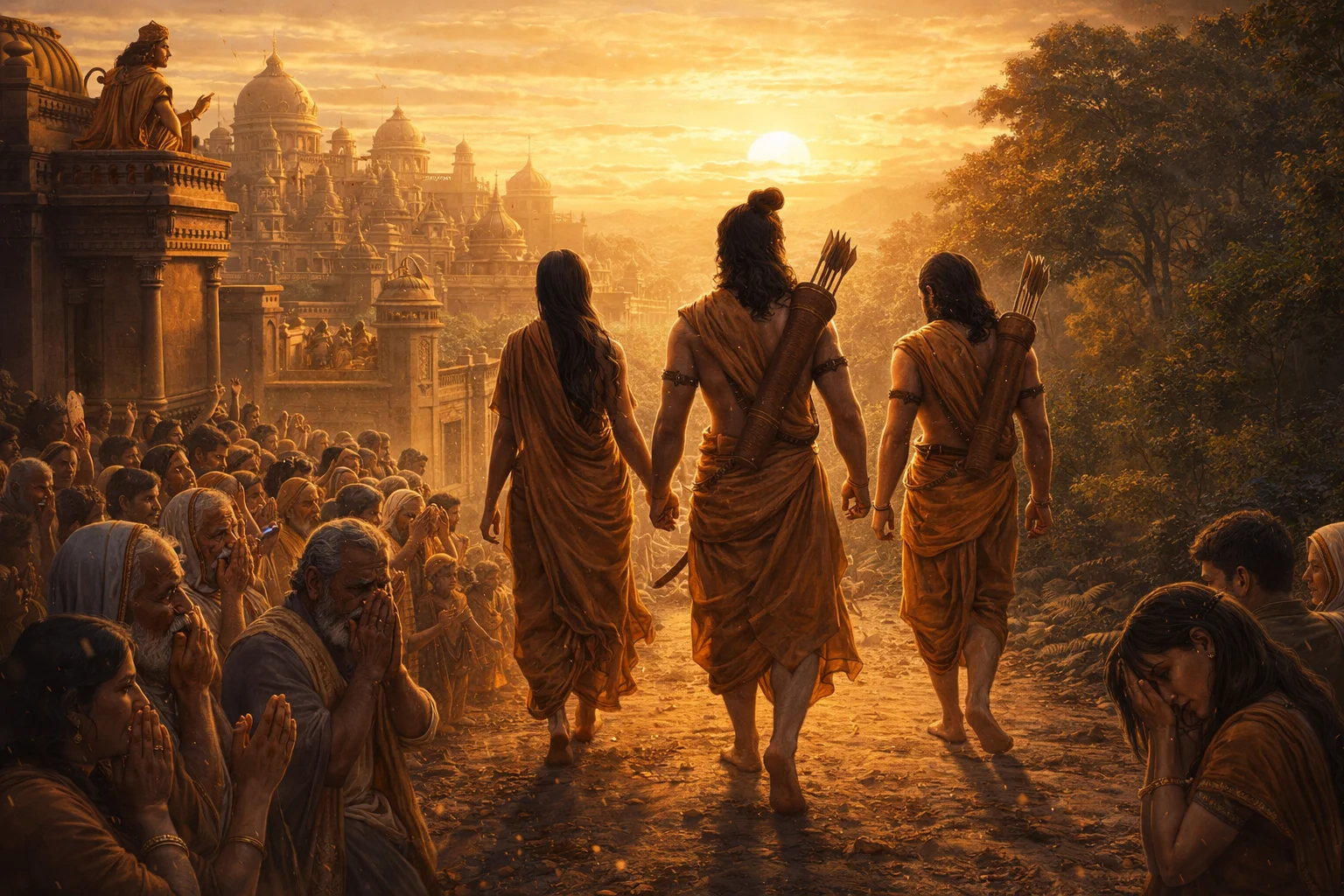
The three — Ramji, Sita Devi, and Lakshmana — walked out of the palace in hermit's clothes. The citizens of Ayodhya followed them weeping to the city gates and beyond, unable to stop, unable to turn back. Dasharatha watched from the palace rooftop until the chariot that carried them to the forest's edge disappeared from sight — and then, with the name of Rama on his lips, he died of grief within days, his heart broken by the separation from the son who was more than a son to him. Bharata, returning from his maternal uncle's home and learning what his mother had done, was devastated. He went to the forest, found Ramji, and begged him to return. Ramji refused: his father's word was given, and it must be honoured to the last day of the fourteen years. Bharata placed Ramji's sandals on the throne and ruled Ayodhya for fourteen years as a regent — not a king — keeping his brother's sandals as the true sovereign of the land.

जब युवराज के रूप में रामजी के राज्याभिषेक की घोषणा हुई तो पूरी अयोध्या उत्सव में थी। किंतु कैकेयी की कुबड़ी दासी मंथरा ने उनके कान भरे: कि रामजी का राज्याभिषेक कौशल्या को सर्वोच्च रानी बना देगा और कैकेयी और उनके पुत्र भरत को अप्रासंगिक। कैकेयी ने वे दो वरदान माँगे जो दशरथ ने उन्हें उनकी प्राण-रक्षा के बदले दिए थे: रामजी का चौदह वर्ष का वनवास और भरत का तत्काल राज्याभिषेक।

दशरथ को जैसे आघात लगा — शब्दों ने उनकी साँस, उनका हृदय, उनकी सोचने की शक्ति रोक दी। उन्होंने याचना की, रोए, तीनों लोकों का सब कुछ देने की पेशकश की। किंतु कैकेयी टस से मस नहीं हुईं और दशरथ उस परम धार्मिक नियम से बंधे थे कि सम्मान पर दी हुई शपथ कभी नहीं तोड़ी जा सकती। रामजी ने यह समाचार सुना। एक क्षण मौन में रहे, फिर पूर्ण शांति के साथ बोले: "पिता की आज्ञा वह परम धर्म है जिसे एक पुत्र पालन करता है। एक राजा का वचन वह आधारशिला है जिस पर उसके राज्य का विश्वास टिका है। मैं जाऊँगा।" कोई क्रोध नहीं, कोई शोक नहीं, कोई बहस नहीं।

सीता देवी ने, जब बताया गया कि वनवास के दौरान उन्हें महल में रहना होगा, शांत निश्चय के साथ मना किया: "जहाँ आप चलते हैं वही मेरा घर है। आपके साथ वन अयोध्या है; आपके बिना अयोध्या वन है।" लक्ष्मण ने कहा: "मैं आ रहा हूँ।" तीनों महल से वानप्रस्थी के वस्त्र पहनकर निकले। अयोध्यावासी रोते हुए नगर के द्वार तक और उससे भी आगे चलते रहे। दशरथ महल की छत से तब तक देखते रहे जब तक रथ दृष्टि से ओझल नहीं हो गया — और फिर राम के नाम के साथ उनका हृदय टूट गया।

भरत, अपनी माँ के कार्य से व्यथित, वन गए और रामजी से लौटने की विनती की। रामजी ने मना किया: उनके पिता का वचन दिया गया था और उसे पूरे चौदह वर्ष सम्मानित होना चाहिए। भरत ने रामजी की पादुकाएं सिंहासन पर रखीं और चौदह वर्ष एक राजप्रतिनिधि की भाँति — राजा नहीं — शासन किया।

Significance  ·  महत्व
This episode establishes Ramji as Maryada Purushottam — the supreme upholder of righteous boundaries. In a world of competing loyalties, Ramji chose the highest dharma without calculation or self-pity. His exile shows that the mark of greatness is not power or success, but integrity under the most unjust circumstances.

वनवास की कथा मर्यादा का सर्वोच्च उदाहरण है। राम ने राजसिंहासन से वन को चुना — पिता के वचन की रक्षा के लिए। भरत का नंदिग्राम में रहकर राज्य चलाना यह दर्शाता है कि सच्चा राजकुमार वह है जो अधिकार नहीं, कर्तव्य चाहता है। व्यक्तिगत सुख से बड़ा है कर्तव्य।

Primary Source
Valmiki Ramayana, Ayodhya Kanda; Ramcharitmanas, Ayodhya Kanda by Tulsidas
Story 3 of 5  ·  कथा ३ / 5
📖 Valmiki Ramayana · Aranya Kanda · Kishkindha Kanda

The Abduction of Sita Devi and the Forest Exile

सीता माँ का अपहरण और वन में खोज

The construction of Ram Setu across the ocean

During the years of forest exile, the demon Ravana — king of Lanka, a scholar of the four Vedas, a veena player of divine skill, a devotee of Shivji who had won extraordinary boons through decades of the most severe tapas — had long coveted Sita Devi. When a demoness reported to him the beauty and virtue of this woman living in the forest with her husband and brother-in-law, Ravana devised a plan. He sent the demon Maricha — an old adversary of Ramji's — disguised as a golden deer of unearthly beauty to appear at the edge of the hermitage at Panchavati. Sita, enchanted by the deer, asked Ramji to catch it for her. Ramji, sensing something wrong but unable to refuse his beloved, followed the golden deer deep into the forest. At the moment of the deer's death it cried out in Ramji's voice: "O Sita! O Lakshmana!" — and Sita, terrified, sent Lakshmana after him despite his certainty that the cry was false.

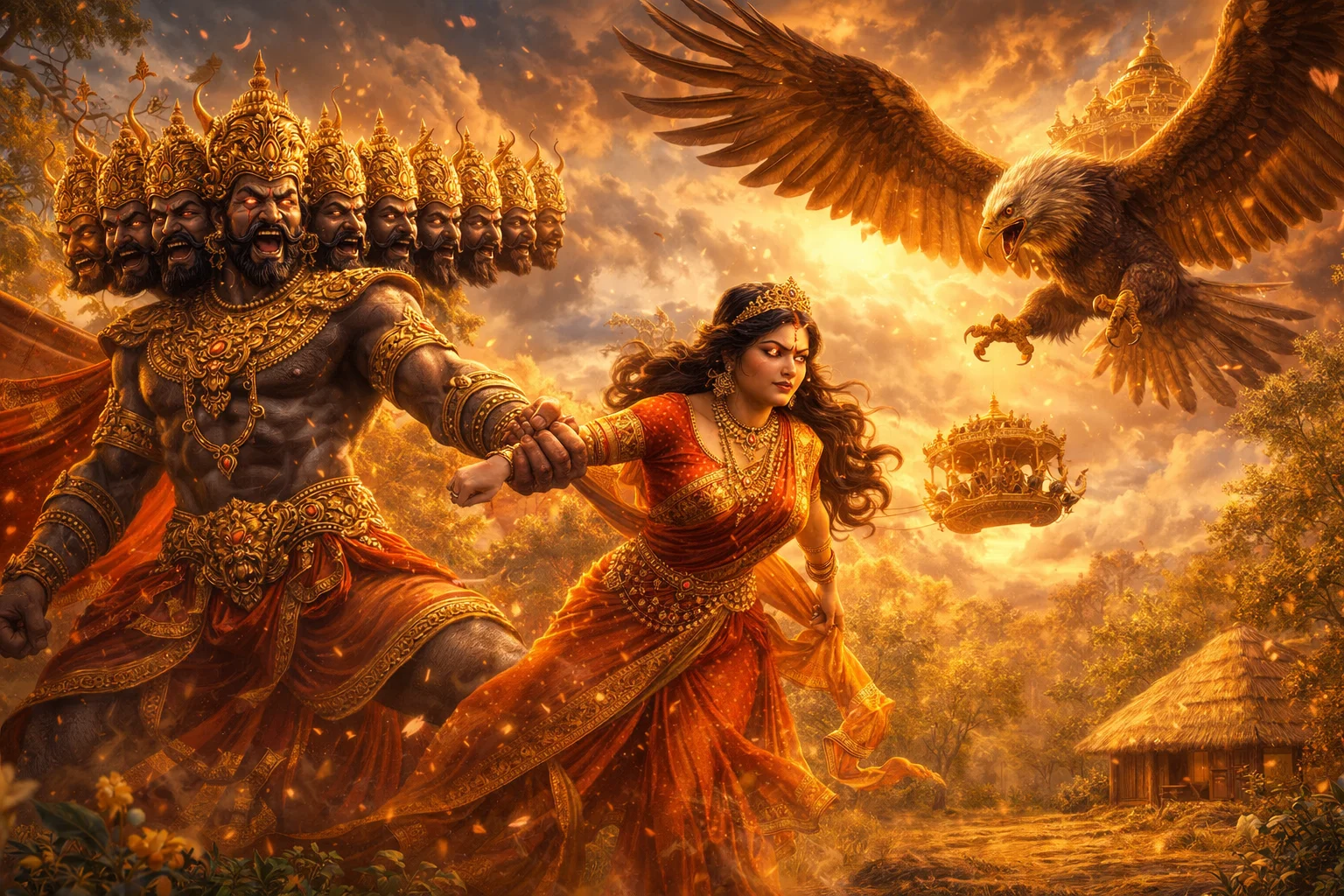
Alone and unprotected, Sita heard a knock at the door. An old sannyasi stood there, lean and ochre-robed, with a begging bowl. She offered him food. But as Sita stepped across the threshold to serve him, Ravana dropped his disguise and revealed himself in his full, terrifying ten-headed form. He declared his desire, praised her beauty, offered her Lanka's queenship, and when she refused with absolute contempt, he seized her by the wrist, tore up a great piece of earth beneath his flying chariot, and carried her screaming through the sky. The great vulture Jatayu — ancient, noble, and an old friend of King Dasharatha — saw the abduction from the sky. Though old and outmatched, he attacked Ravana's chariot with everything he had, raking Ravana's arms and breaking the chariot's wheels. Ravana cut off both Jatayu's wings with a single sweep of his sword.

Ramji and Lakshmana, returning to an empty hermitage, searched with mounting desperation through the forest. They found Jatayu dying on the earth — wings severed, body broken, but alive just long enough to tell Ramji what had happened and which direction Ravana had gone. Ramji wept over Jatayu and gave him the last rites that a son gives a father — an act of profound grace, for Jatayu had given everything he had. Searching further south, they encountered the disfigured demon Kabandha and the she-ascetic Shabari — a woman of low birth whose decades of devotion to Ramji had made her hermitage a place of grace. She had waited her entire long life for Ramji to arrive, preserving fruits that she tasted to find the sweetest ones for him. Ramji accepted her berries with joy, sat with her, and ate the food of her devotion — seeing only her love, not her birth or station. Shabari's eyes closed in liberation as Ramji's feet touched her threshold.

Through Kabandha's dying counsel, Ramji sought Sugriva, the exiled vanara prince, on the Rishyamukha mountain. Their meeting — brokered by the ever-present Hanumanji, who came down the mountain in the guise of a brahmin and immediately recognised Ramji — was one of the pivotal alliances of the epic. Ramji and Sugriva made a covenant: Ramji would slay the usurper Vali and restore Sugriva to his throne; Sugriva would marshal all the vanaras of the world to help find Sita Devi. Ramji fulfilled his side first — watching the brothers fight and then shooting Vali with a single arrow from behind a tree. This act, questioned by Vali with his dying breath, reveals the complexity and moral weight the Valmiki Ramayana holds without flinching — a reminder that even the most righteous are tested by circumstances that offer no clean choices.

वनवास के वर्षों में, राक्षस राजा रावण — लंका का राजा, चारों वेदों का विद्वान, शिवजी का भक्त जिसने दशकों की कठोर तपस्या से असाधारण वरदान पाए थे — सीता देवी को पाने की लालसा रखता था। जब एक राक्षसी ने उसे बताया कि वन में अपने पति और देवर के साथ रह रही इस स्त्री की सुंदरता और गुण कैसे हैं, रावण ने एक योजना बनाई। उसने राक्षस मारीच को — रामजी का एक पुराना शत्रु — पंचवटी की झोपड़ी के पास अलौकिक सुंदरता वाले सोने के हिरण के रूप में प्रकट होने भेजा। सीता ने मोहित होकर रामजी से उसे लाने का आग्रह किया।

अकेली और असुरक्षित सीता ने एक वृद्ध संन्यासी को दरवाजे पर भिक्षा माँगते देखा। उन्होंने भोजन अर्पित किया। किंतु जैसे ही सीता परोसने के लिए देहरी पार की, रावण ने अपना भेष छोड़ा और भयंकर दस सिरों वाले रूप में प्रकट हुआ। उसने उनकी कलाई पकड़ी, अपने उड़ते रथ के नीचे की धरती उखाड़ी और उन्हें चीखती हुई आकाश में ले गया। विशाल गिद्ध जटायु — वृद्ध, राजा दशरथ का पुराना मित्र — ने आकाश से यह अपहरण देखा। उसने रावण के रथ पर अपनी पूरी शक्ति से आक्रमण किया, रावण की भुजाएं नोंचीं और रथ के पहिए तोड़े। रावण ने एक ही वार में जटायु के दोनों पंख काट दिए।

रामजी और लक्ष्मण वापस खाली झोपड़ी लौटे और बढ़ती बेचैनी के साथ वन में खोजते रहे। उन्हें धरती पर मरणासन्न जटायु मिला — पंख कटे, शरीर टूटा, किंतु इतना ज़िंदा कि रामजी को बता सके क्या हुआ और रावण किस दिशा में गया। रामजी ने जटायु का रुदन किया और उन्हें वह अंत्येष्टि दी जो एक पुत्र पिता को देता है।

कबंध राक्षस और तपस्विनी शबरी से होते हुए — शबरी जो जन्म से निम्न वर्ण की थीं किंतु जिनकी भक्ति ने उनके आश्रम को कृपा का स्थान बना दिया था, जिन्होंने जीवन भर रामजी के आने की प्रतीक्षा की और उनके लिए मीठे फल चखकर रखे थे — रामजी सुग्रीव से मिले। रामजी और सुग्रीव की यह मित्रता, जिसमें हनुमानजी मध्यस्थ थे, महाकाव्य की एक महत्वपूर्ण संधि थी। रामजी ने बाली का वध किया और सुग्रीव ने समस्त वानर-सेना को सीता देवी की खोज में जुटाने का वचन दिया।

Significance  ·  महत्व
The abduction of Sita Devi shows the eternal truth that dharma faces its greatest tests not through open warfare but through guile and deception. Jatayu's sacrifice — an old bird fighting to his last breath for righteousness — is one of the most moving examples of selfless courage in the Ramayana. And Ramji's grief and his performing Jatayu's last rites shows that the divine is not above love and loss.

सीता हरण और राम की खोज की कथा यह सिखाती है कि विपत्ति में भी धर्म का मार्ग नहीं छोड़ना चाहिए। राम ने हर प्राणी को — चाहे वह गिद्ध हो, वानर हो, या गिलहरी हो — सम्मान और महत्व दिया। यही उनकी मर्यादा है। प्रेम में शक्ति होती है — राम की सेना वानरों की थी, फिर भी विजयी हुई।

Primary Source
Valmiki Ramayana, Aranya Kanda (सुंदर वन); Kishkindha Kanda
Story 4 of 5  ·  कथा ४ / 5
📖 Valmiki Ramayana · Yuddha Kanda

The Lanka War and Ravana's Defeat — Dharma Restored

लंका युद्ध और रावण वध — धर्म की विजय

Shri Ramji defeating Ravana in Lanka

With the full vanara army of Sugriva — hundreds of thousands strong — Ramji marched to the southern shore. One hundred yojanas of open ocean lay between the shore and Lanka, invisible in the distance. The army halted, uncertain. Ramji prayed to the ocean for three days to grant him passage, and when the ocean did not appear, he took his bow in divine anger and threatened to dry it up. The ocean-god Samudra appeared at last, prostrated, and revealed that two vanaras among them — Nala and Nila — had the power to make stones float by touching them, a gift from their birth. In five days, the entire vanara army built the bridge of Rama Setu across the ocean — stones inscribed with Ramji's name floating as easily as leaves. The bridge stands, say the scriptures, as an eternal monument to devotion and collective effort.

The war of Lanka was not swift. Ravana commanded the most powerful army in all three worlds, led by warriors of extraordinary capacity: his son Meghnad (Indrajit), who had defeated Indra himself in battle; his brother Kumbhakarna, a colossus who slept for six months at a time; and legions of rakshasas trained in maya-yuddha — the warfare of illusion. Ravana's own might was so vast that he had moved the planets from their courses with his arms. One by one the great commanders fell — Dhumraksha, Akampana, Prahasta — and then in one terrible night, Indrajit used the Nagapasha weapon to bind the entire vanara army including Ramji and Lakshmana in serpent nooses. Only the divine eagle Garuda's arrival released them.

The darkest moment came when Indrajit struck Lakshmana with the Shakti weapon and left him lying as if dead. The physician Sushena declared that only the Sanjeevani herb from Mount Dronagiri in the Himalayas, brought before sunrise, could revive him. The impossible task fell to Hanumanji, who flew through the night sky, reached the Himalayas, and — unable to identify the specific herb — lifted the entire mountain and carried it back to Lanka before dawn broke. Lakshmana was revived. Indrajit was eventually slain by Lakshmana in a sustained and ferocious battle. Kumbhakarna fell. At last, Ramji and Ravana faced each other on the battlefield. Ravana's ten heads fell one by one under Ramji's arrows and grew back, until Vibhishana revealed the secret: the nectar of immortality stored in Ravana's navel. Ramji's Brahmanda astra pierced it. Ravana fell.

The victory was not celebrated in exultation but in the gravity of loss: the battlefield was littered with the dead of both sides, and Ravana himself — despite all his crimes, despite the abduction of Sita, despite the years of war — was given a funeral with full honour by Ramji himself. "He was a great scholar, a great devotee, and a great king," Ramji said. "His great qualities did not desert him even in his fall. Honour him." This magnanimity in absolute victory is one of the Ramayana's most defining moments: it shows that Ramji's war was never against Ravana as a person, but against the adharma that Ravana had chosen to embody — and when the adharma was ended, there was no hatred left, only the dharmic obligation to honour what was truly great in the enemy. Sita Devi emerged from the Ashoka Vatika, and the universe breathed again.

सुग्रीव की सम्पूर्ण वानर-सेना के साथ — लाखों की संख्या में — रामजी दक्षिण तट पर पहुँचे। तट और लंका के बीच सौ योजन का खुला समुद्र था। रामजी ने तीन दिन समुद्र देव से प्रार्थना की। जब समुद्र नहीं आया, उन्होंने दिव्य क्रोध में अपना धनुष उठाया और समुद्र को सुखाने की धमकी दी। समुद्र देव अंततः प्रकट हुए और बताया कि सेना में नल और नील — जिन्हें जन्म से पत्थरों को स्पर्श करके तैराने की शक्ति थी — हैं। पाँच दिनों में पूरी वानर सेना ने राम सेतु का निर्माण किया।

लंका का युद्ध सरल नहीं था। रावण के पास तीनों लोकों की सबसे शक्तिशाली सेना थी: उसका पुत्र मेघनाद जिसने इंद्र को हराया था, उसका भाई कुंभकर्ण जो छह महीने सोता था, और माया-युद्ध में प्रशिक्षित राक्षसों की सेना। एक भयानक रात में, मेघनाद ने नागपाश से समस्त वानर सेना सहित रामजी और लक्ष्मण को बाँध दिया — केवल दिव्य गरुड़ के आगमन से मुक्ति मिली।

सबसे अंधेरा क्षण तब आया जब मेघनाद ने शक्ति-अस्त्र से लक्ष्मण को अर्धमृत अवस्था में गिरा दिया। वैद्य सुषेण ने कहा — केवल हिमालय के द्रोणागिरि पर्वत से संजीवनी जड़ी-बूटी, सूर्योदय से पहले। असंभव कार्य हनुमानजी पर पड़ा। वे रात के आकाश में उड़ चले। हनुमानजी हिमालय पहुँचे किंतु उस अंधेरे में विशिष्ट जड़ी न पहचान पाए — और पूरा पर्वत उठा लाए। लक्ष्मण जीवित हुए। अंततः रावण के नाभि में स्थित अमृत का रहस्य विभीषण ने बताया और रामजी के ब्रह्मास्त्र ने रावण का वध किया।

रावण की अंत्येष्टि रामजी ने स्वयं पूरे सम्मान के साथ करवाई। "वे महान विद्वान, महान भक्त और महान राजा थे। उनके महान गुण पतन में भी उन्हें नहीं छोड़े। उनका सम्मान करो।" यह पूर्ण विजय में यह उदारता रामायण के सबसे परिभाषक क्षणों में से एक है। सीता देवी अशोक वाटिका से निकलीं और ब्रह्मांड ने साँस ली।

Significance  ·  महत्व
The Lanka war and Ravana's defeat teach the central lesson of the Ramayana: extraordinary gifts, power, and even devotion to god cannot save someone whose fundamental orientation is toward ego and desire rather than righteousness. Ravana had everything except the one thing that mattered — freedom from his own ego. Ramji had everything because of the one thing that cannot be taken: integrity.

लंका युद्ध केवल एक युद्ध नहीं — धर्म और अधर्म के बीच का संघर्ष है। राम की विजय यह सिखाती है कि अंततः सत्य और न्याय की विजय होती है। रावण से अंतिम ज्ञान लेना यह बताता है कि शत्रु से भी विनम्रता से सीखना चाहिए। दीपावली का उत्सव इसी विजय और वापसी का उत्सव है।

Primary Source
Valmiki Ramayana, Yuddha Kanda (लंका युद्ध, रावण वध, सीतोद्धार)
Story 5 of 5  ·  कथा ५ / 5
📖 Valmiki Ramayana · Uttara Kanda · Ramcharitmanas

The Return to Ayodhya and Ramrajya

अयोध्या वापसी और रामराज्य

Shri Ramji's triumphant return to Ayodhya

Fourteen years to the day, the period of exile was complete. Hanumanji had been sent ahead to Ayodhya to inform Bharata of Ramji's imminent return and to ensure that the city was prepared. The reunion between Bharata and Hanumanji — and Bharata's reaction to the news that his brother was finally coming home — is one of the most emotionally charged scenes in the Ramayana. Bharata, who had ruled for fourteen years with Ramji's sandals on the throne, who had lived as an ascetic refusing all royal luxuries, who had sworn to enter fire if his brother did not return on the appointed day — wept at the news and immediately set the preparations in motion for the grandest homecoming the world had ever seen.

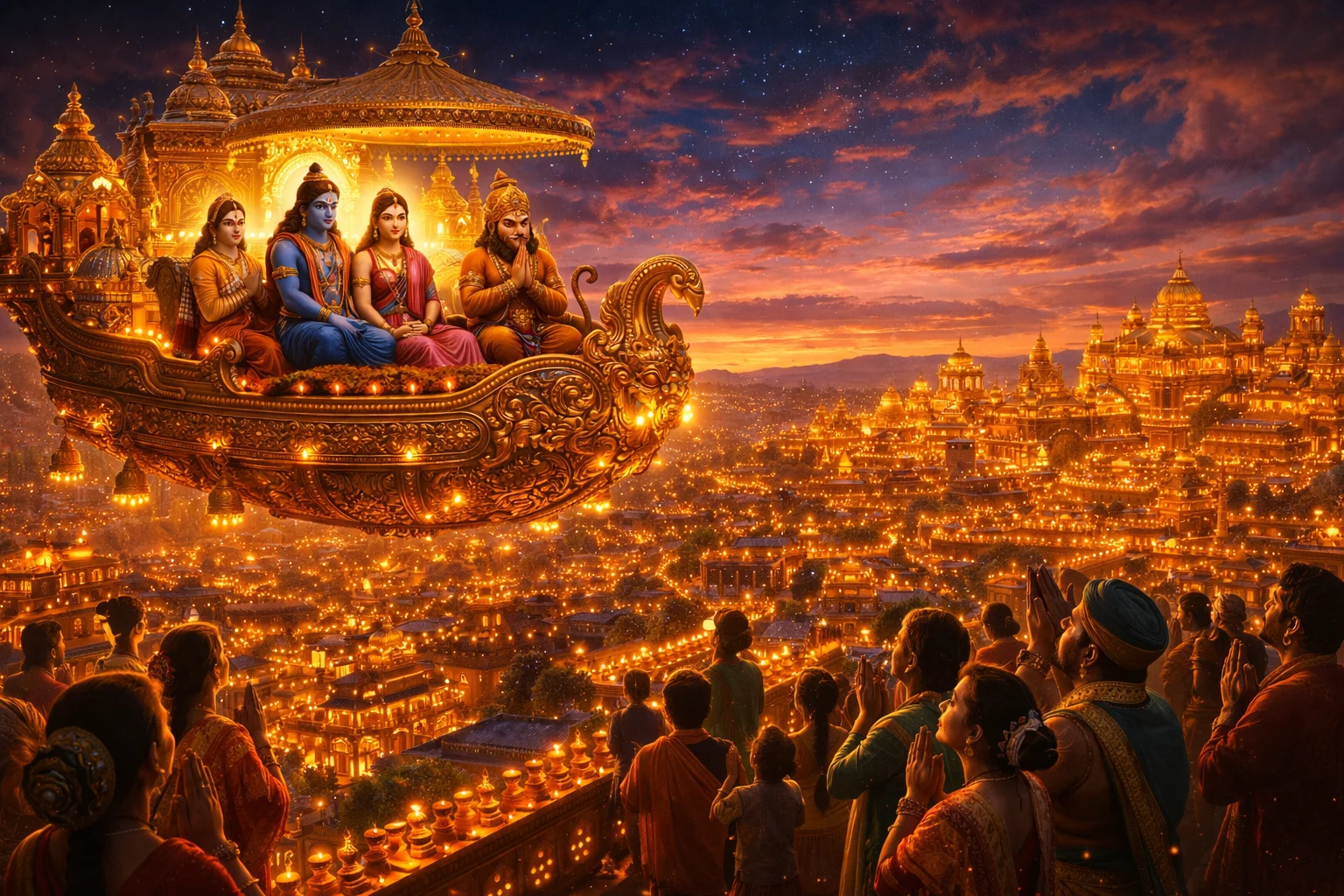
When the Pushpaka Vimana — the aerial chariot of Lanka, now in Ramji's service — descended over Ayodhya, the city was lit with hundreds of thousands of earthen lamps: every home, every road, every rooftop blazing with light in the darkness, as though the city itself had become a constellation of stars come down to earth. This is Diwali — Deepavali, the row of lights — the festival celebrated by hundreds of millions of people to this day as the return of dharma's light to a world that had been in the shadow of fear. The moment when Ramji set foot in Ayodhya, the people of the city felt it not merely as the return of their king but as the return of everything good — safety, order, justice, love — which had been absent for fourteen years.

The coronation of Ramji as King of Ayodhya inaugurated what the Ramayana describes as Ramrajya — Ram's kingdom, the ideal society. The Valmiki Ramayana describes it in precise detail: no one died young or before their time, no mother wept for her child, no one was hungry, the rains came when needed and the sun shone when needed, the forests were full and the rivers were clear, the merchants were honest, the scholars were honoured, and the king's dharma radiated outward through every layer of society like warmth from a fire at the centre of a room. Even the trees, the Ramayana says, bore fruit in all seasons; even the birds and animals lived without fear of one another. Ramrajya is not merely a political ideal — it is the condition of the entire natural world when dharma is at the centre.

Ramji ruled for eleven thousand years, the scriptures say, and in all that time never departed from dharma by a single step. His story does not end — not in the sense that matters most. The Ramayana's final message is that Ramji is not a historical figure locked in time but a living presence: the name Rama, the ancient texts insist, is not a man's name but the name of the supreme reality compressed into sound. "Ra" is the fire syllable from the Ashtakshara mantra of Vishnu; "Ma" is the fire syllable from the Panchakshara mantra of Shivji. The two syllables together form Taraka Brahma — the crossing mantra, the syllables that carry the soul across the ocean of existence. This is why, across all of India, the passing of the dead is accompanied by the chant: Ram Nam Satya Hai — the name of Ram is truth.

ठीक चौदह वर्ष पूरे होने पर वनवास समाप्त हुआ। हनुमानजी को आगे भेजा गया कि भरत को रामजी के आगमन की सूचना दें और नगर की तैयारी करें। भरत की प्रतिक्रिया — जो चौदह वर्ष रामजी की पादुकाओं को सिंहासन पर रखकर तपस्वी की भाँति जिए थे, जिन्होंने शपथ ली थी कि यदि भाई नियत दिन नहीं लौटे तो वे अग्नि में प्रवेश कर लेंगे — रामायण के सबसे भावपूर्ण दृश्यों में से एक है। वे यह सुनकर फूट-फूटकर रोए।

जब पुष्पक विमान अयोध्या के ऊपर उतरा, नगर लाखों मिट्टी के दीपकों से जगमग था: हर घर, हर सड़क, हर छत दीपकों से जलती हुई — मानो नगर स्वयं आकाश से उतरे तारों का एक समूह बन गया हो। यही दीपावली है — दीपों की पंक्ति — वह त्यौहार जो आज भी करोड़ों लोग मनाते हैं।

रामजी के राज्याभिषेक ने रामराज्य का उद्घाटन किया — वह आदर्श समाज। वाल्मीकि रामायण उसका सटीक वर्णन करती है: कोई समय से पहले नहीं मरता था, कोई माँ अपने बच्चे के लिए नहीं रोती थी, कोई भूखा नहीं था, वर्षा समय पर होती थी, जंगल पूर्ण थे, नदियाँ स्वच्छ थीं, व्यापारी ईमानदार थे, विद्वानों का सम्मान था। यहाँ तक कि पेड़ सब मौसमों में फल देते थे, पक्षी और पशु एक-दूसरे से निडर होकर जीते थे।

रामराज्य केवल एक राजनैतिक आदर्श नहीं — यह समस्त प्राकृतिक जगत की वह अवस्था है जब धर्म केंद्र में हो। रामजी का जीवन यह सिखाता है कि राजा का सर्वोच्च कर्तव्य प्रजा का कल्याण है। रामायण का अंतिम संदेश यह है कि रामजी इतिहास में बंद कोई व्यक्ति नहीं बल्कि एक जीवित उपस्थिति हैं: "राम" केवल एक नाम नहीं बल्कि वह ध्वनि है जिसमें परम सत्य समाया है — 'रा' विष्णु के अष्टाक्षर मंत्र की अग्नि वर्ण, 'म' शिवजी के पंचाक्षर मंत्र की अग्नि वर्ण। यही कारण है कि मृत्यु के साथ "राम नाम सत्य है" का उच्चारण होता है।

Significance  ·  महत्व
The return of Ramji and the establishment of Ramrajya is the culminating vision of the Ramayana: that dharma, once it endures its full testing, returns more radiant than before. Diwali — celebrated by hundreds of millions of people across the world — commemorates this moment. Ramrajya is not just a historical ideal but a living aspiration: the possibility of a society built on truth, compassion, and justice.

रामराज्य आदर्श शासन का प्रतीक है। राम का जीवन यह सिखाता है कि राजा का सर्वोच्च कर्तव्य प्रजा का कल्याण है, चाहे उसके लिए व्यक्तिगत सुख का त्याग करना पड़े। सीता का धरती में समाना — एक माँ का अपनी पुत्री को वापस लेना — प्रकृति की अंतिम न्याय है। रामराज्य आज भी सुशासन का आदर्श है।

Primary Source
Valmiki Ramayana, Yuddha Kanda and Uttara Kanda; Ramcharitmanas, Uttara Kanda by Tulsidas