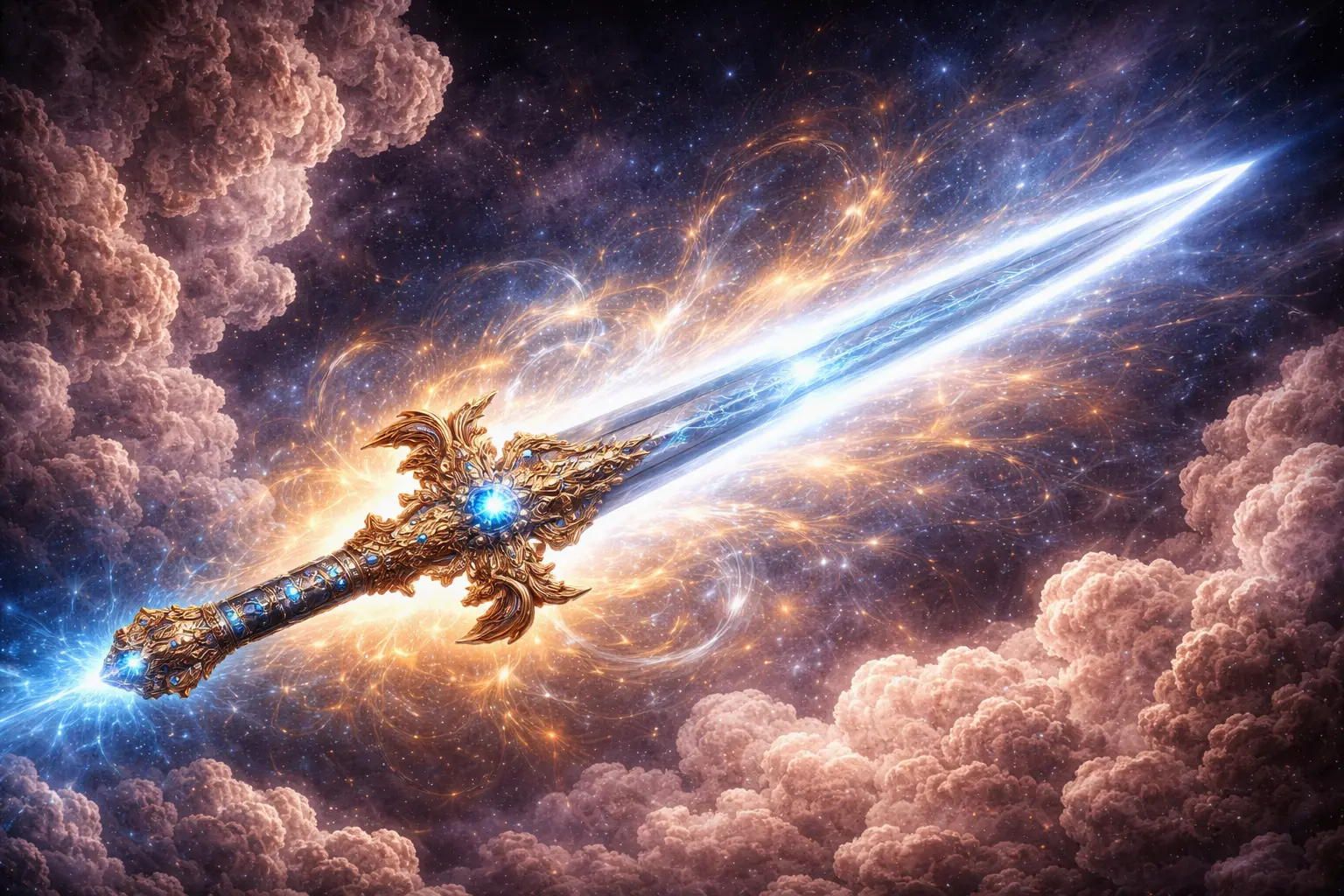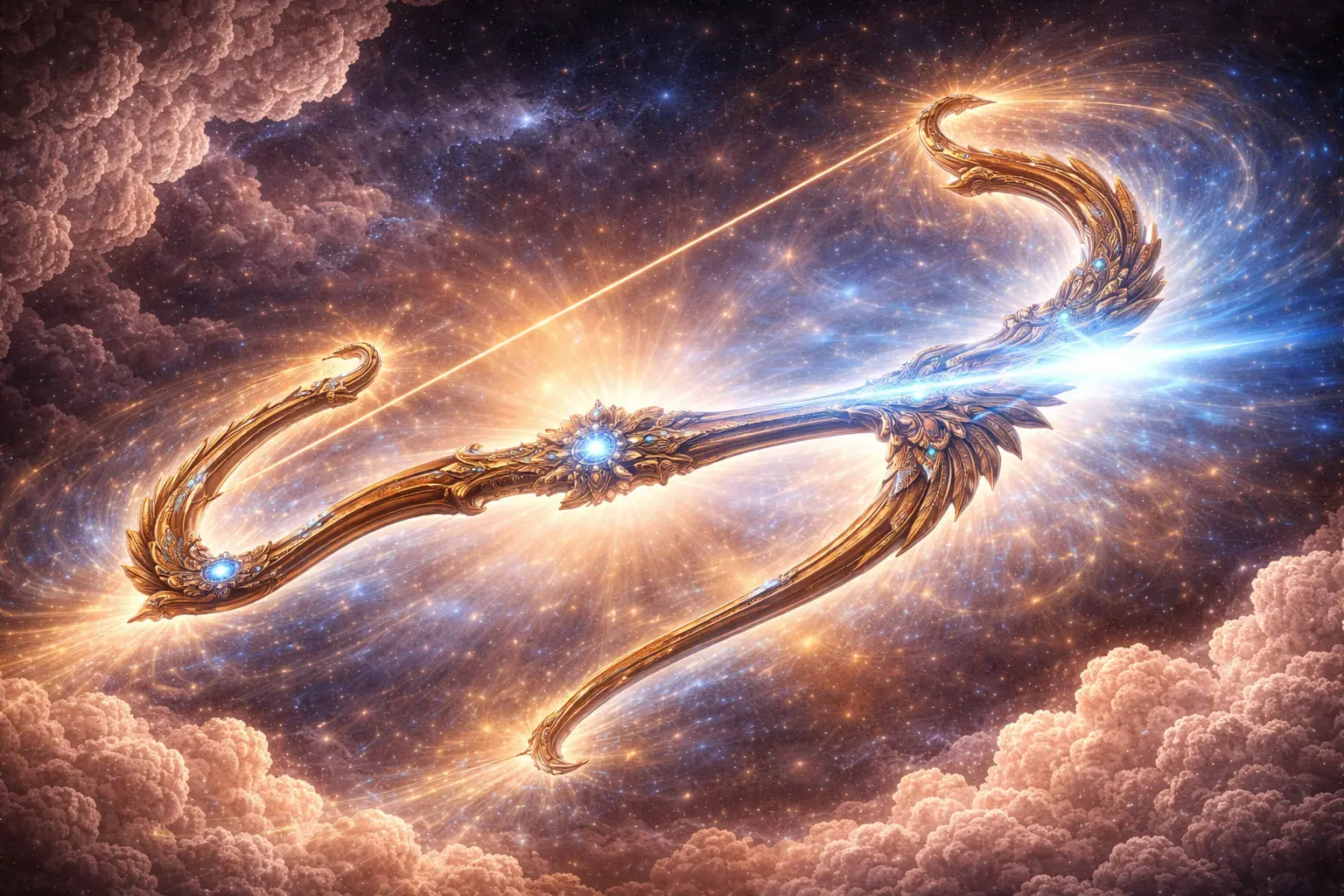
Mythology · Astra & Shastra

Divine Weapons of the Gods देवताओं के दिव्य अस्त्र-शस्त्र

In Hindu mythology, divine weapons are not merely tools of war — they are extensions of cosmic consciousness, manifestations of divine will. From Vishnu's spinning Sudarshan Chakra to Shiva's annihilating Pashupatastra, each weapon carries a universe of story, symbolism, and spiritual meaning. This is the complete guide to the 14 greatest divine weapons of Hinduism.

14 Divine Weapons
5 Deities Featured
3 Sacred Texts
Introduction

What Are Astra and Shastra?

🌟
Astra — Supernatural Missile

An Astra is a weapon invoked through a mantra (sacred chant) or mental intent. It is typically released from a bow or by hand, charged with divine energy. Once released, it cannot be recalled except by a counter-Astra. Examples: Brahmastra, Pashupatastra, Narayanastra. Astras are essentially divine projectile spells — weapons of mass destruction in the hands of the worthy.

⚔️
Shastra — Sacred Physical Weapon

A Shastra is a physical weapon directly wielded by hand — a sword, mace, trident, or chakra. The wielder's skill, devotion, and divine blessing determine its power. Examples: Trishul, Kaumodaki, Nandaka sword, Sudarshan Chakra. Shastras are permanent divine artifacts, often created by Vishwakarma (the divine architect) and gifted to gods.

The tradition of divine weapons (Divyastras) forms the backbone of cosmic warfare in Hindu mythology. These weapons are not merely material objects — they are consciousness itself, condensed into destructive or protective force. The Vedas speak of weapons as shakti (divine energy) made tangible. A warrior who receives a Divyastra must undergo a long apprenticeship, observe celibacy and discipline, and invoke the weapon's presiding deity through the correct mantra.

Across the Ramayana, Mahabharata, and the eighteen Puranas, these weapons appear at pivotal moments — turning the tide of cosmic battles, resolving impossible situations, and demonstrating the absolute supremacy of righteousness. Lord Shiva alone possesses the Trishul, Pinaka, and Pashupatastra. Lord Vishnu and Krishna wield the Sudarshan Chakra, Nandaka, Sharanga, and Kaumodaki. Together, their arsenals embody the full spectrum of creation, preservation, and dissolution.

🔱
Weapon 01 · Shastra · Bow
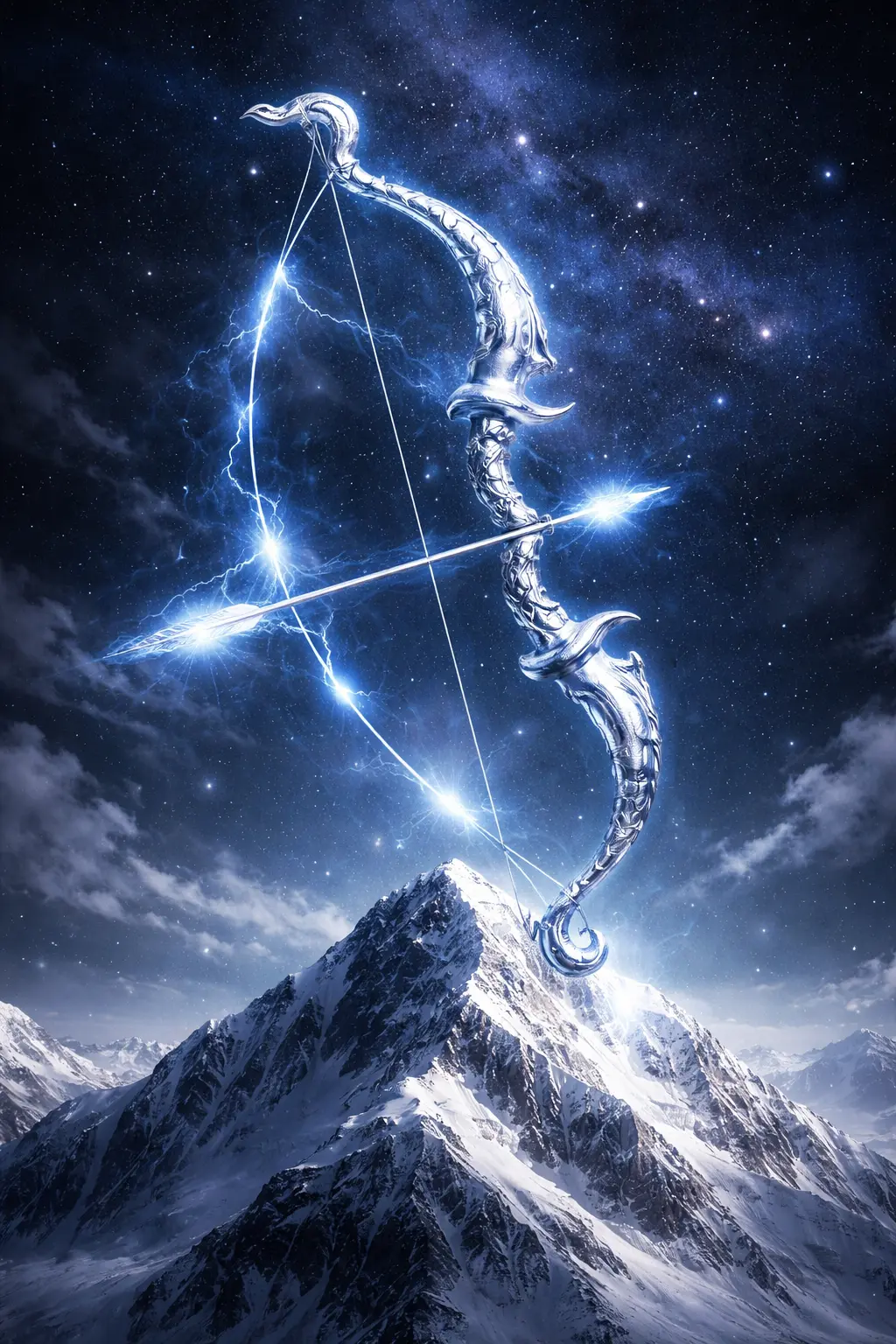
Pinaka — Shiva's Divine Bow 🏹

Pinaka

पिनाक — शिवजी का दिव्य धनुष
🔱 Owned by Lord Shiva
Ramayana Swayamvara Shiva's Bow
OriginCrafted by Vishwakarma, gifted by Shiva
Also CalledShiva Dhanush, Shiv Dhanusha
Key EventSita Swayamvara, Ram breaks it
Appears InValmiki Ramayana, Padma Purana

The Pinaka is perhaps the most famous bow in all of Hindu mythology — not for its use in battle, but for the legendary act of stringing it that changed the course of Indian civilization. According to the Valmiki Ramayana, the Pinaka was crafted by Vishwakarma, the divine architect of the gods, and presented to Lord Shiva as a supreme gift. The bow was said to carry the weight of a thousand mountains — not merely as a physical bow, but as an embodiment of Shiva's infinite cosmic power.

The Pinaka's most celebrated appearance occurs in Mithila, the kingdom of King Janaka. Janaka had received the divine bow from his ancestor, and no mortal king, warrior, or sage could so much as lift it. Janaka declared a swayamvara (self-choice ceremony) for his daughter Sita — the incarnation of Lakshmi — proclaiming that whoever could string the Pinaka would win her hand. Thousands of kings arrived, each desperate to prove their strength. The great king Ravana himself came — whose arms could shake the Himalayas — and failed to even move the bow from its display pedestal.

Then came Shri Ram, the seventh avatar of Vishnu, accompanied by sage Vishwamitra. When Ram approached the Pinaka, it was not an act of muscular effort — it was a divine meeting of destined souls. Ram lifted the bow effortlessly, a sight that silenced the entire assembly. When he pulled the string to string it, the bow did not just bend — it snapped with a sound so thunderous that the earth shook and the gods trembled in their heavens. The breaking of the Pinaka at that moment was interpreted by the assembled sages as cosmic confirmation: Ram was no ordinary prince but the Supreme Being incarnate.

There is a deeper layer to this story. The Shiva Purana suggests that the snapping of the Pinaka was not just a feat of strength — it was the end of one cosmic era and the beginning of another. Shiva's weapon, representing dissolution (the end of obstacles), was broken so that Vishnu's era of preservation and dharma could be established through Ram's reign.

धनुषां श्रेष्ठं पिनाकं नाम विश्रुतम् ।
यत् तत् शिवसमायुक्तं सर्वदेवनमस्कृतम् ॥
"The supreme among bows, renowned as Pinaka, that which is united with Shiva and worshipped by all the gods."
Weight of a thousand mountains — unmovable by mortal or demon
🌍Its stringing or snapping creates earthquakes felt across realms
🔱Contains the essence of Shiva's destructive power — Pralaya Shakti
🧪A cosmic filter — only a being of equal divine status can move it
📖 Valmiki Ramayana 📖 Padma Purana 📖 Shiva Purana 📖 Adhyatma Ramayana
Weapon 02 · Shastra · Spinning Disc
Sudarshan Chakra of Lord Vishnu ☸️

Sudarshan Chakra

सुदर्शन चक्र — विष्णु का दिव्य चक्र
🦚 Owned by Lord Vishnu / Krishna
Mahabharata Bhagavata Purana Vishnu's Weapon
ShapeSpinning disc, 108 serrated edges
SanskritSu (good) + Darshan (vision)
Presiding DeityLord Vishnu, carried by Krishna
Never MissesReturns to wielder after striking

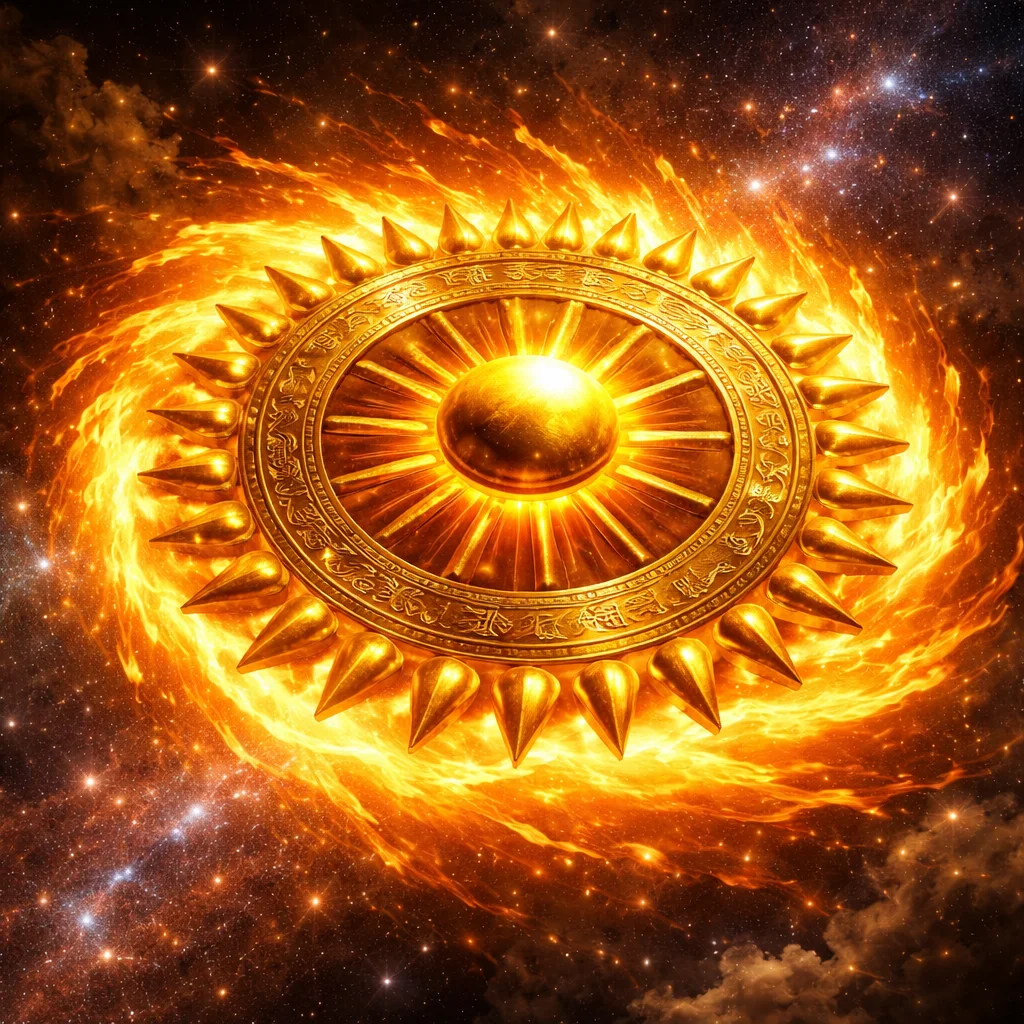
The Sudarshan Chakra is Vishnu's most iconic weapon — a spinning disc of blazing light that serves as the ultimate expression of his will across the cosmos. According to the Vishnu Purana, the Chakra was fashioned by Vishwakarma from the fiery mass of the Sun itself. When the Sun's unbearable radiance was being chiseled down by Vishwakarma to make it bearable for Sanjna (the Sun's wife), the trimmings of solar fire were used to create divine weapons — the Sudarshan Chakra chief among them.

The name carries deep meaning: Sudarshan means "beautiful vision" or "auspicious sight." In Vaishnavism, merely seeing the Chakra grants liberation. It is not just a weapon but a cosmic vision of divine order — it destroys everything that is opposed to dharma and protects all that upholds it.

In the Mahabharata, Lord Krishna's most dramatic use of the Sudarshan Chakra occurred on the 14th day of the Kurukshetra war. Arjuna had vowed — under tremendous provocation — to kill Jayadratha, king of Sindhu, before sunset or immolate himself. As the sun began to set and Jayadratha remained alive and protected by the Kaurava army, it seemed the vow would fail. At that critical moment, Krishna used his Sudarshan Chakra to create an artificial eclipse — hiding the sun with the spinning disc to create the appearance of sunset. Jayadratha, believing Arjuna had failed, emerged from hiding to celebrate — and was immediately killed by Arjuna's arrow.

Earlier, on the 9th day of the war, Krishna himself threatened to personally use the Chakra against Bhishma. Despite having vowed not to take up weapons, such was Bhishma's assault on Arjuna that Krishna leapt from the chariot to destroy the grandsire himself. Bhishma, overcome with devotion, prostrated before Krishna — famously declaring he would welcome liberation from the Sudarshan Chakra. Only Arjuna's pleading stopped Krishna from breaking his own vow.

The Chakra also plays a central role in the Bhagavata Purana's stories of Vishnu's protection of devotees. When the demon Sudarshana tormented a kingdom, Vishnu's Chakra hunted him across all three worlds, ending his terror. In the story of Ambarisha, the great devotee, the Chakra chased the sage Durvasa — who had wronged Ambarisha — across the cosmos, through Brahmaloka and Shivaloka, retreating only when Durvasa made amends.

🌀Spins at the speed of thought — arrives before the command is fully formed
☀️Made from solar fire — can create artificial eclipses, alter cosmic timing
🌊Can destroy demons across multiple dimensions simultaneously
👁️Grants liberation (moksha) to any being it slays
🔄Always returns to Vishnu's finger after striking its target
📖 Mahabharata 📖 Bhagavata Purana 📖 Vishnu Purana 📖 Harivamsa
Weapon 03 · Shastra · Trident
Trishul of Lord Shiva 🔱

Trishul

त्रिशूल — महादेव का त्रिशूल
🔱 Owned by Lord Shiva
Shiva Purana Devi Bhagavata Trinity Symbol
StructureThree-pronged spear
Three ProngsCreation, Preservation, Destruction
Also RepresentsPast, Present, Future
Given ToDurga Mata for demon slaying

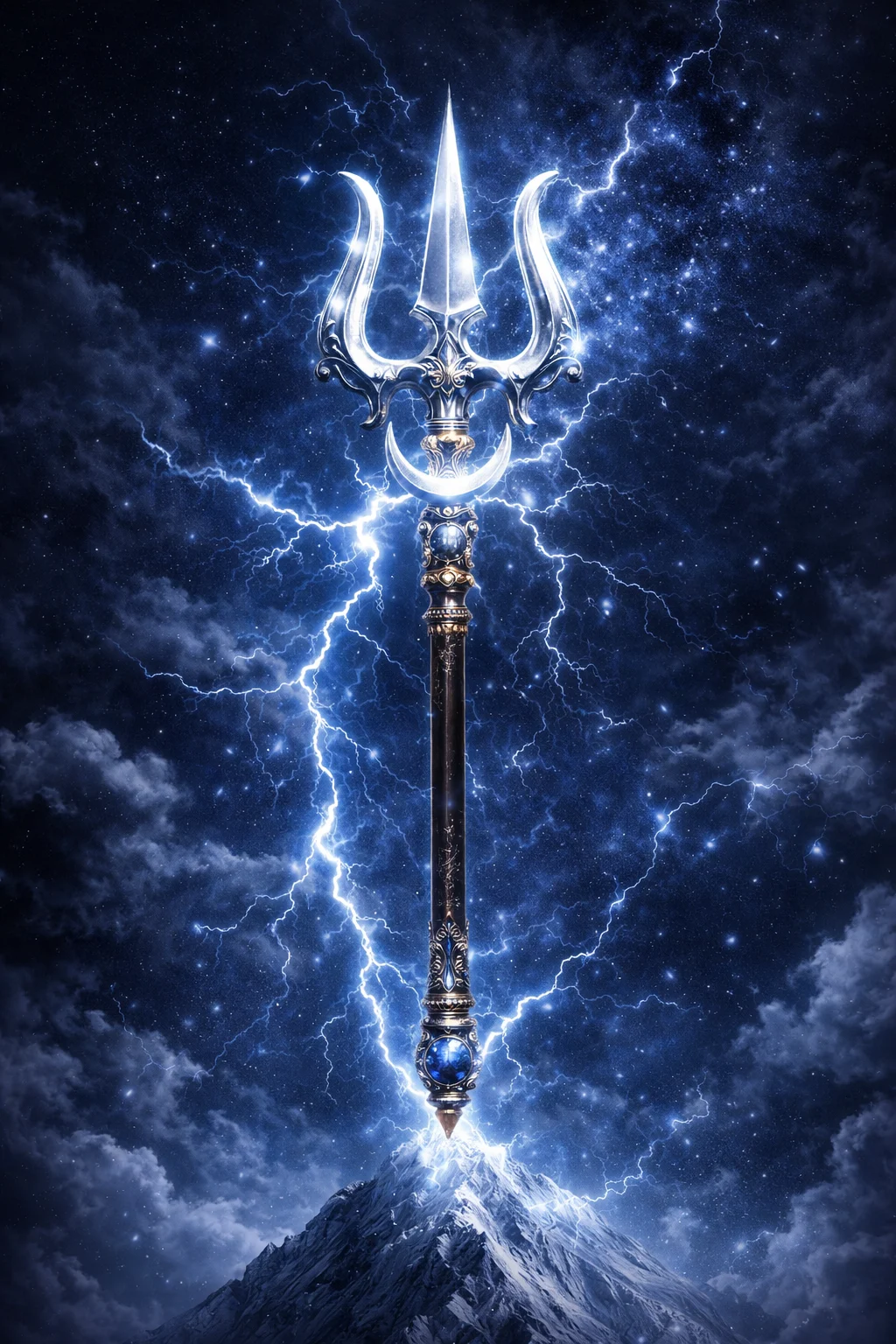
The Trishul of Lord Shiva is more than a weapon — it is the symbolic condensation of his three fundamental cosmic functions. The three prongs embody the Trinity (Brahma, Vishnu, Mahesh) as forces of creation, preservation, and dissolution. They simultaneously represent the three qualities of nature (trigunas: Sattva, Rajas, Tamas), the three states of consciousness (waking, dreaming, deep sleep), and the three realms of existence (Swarga, Bhumi, Patala). To hold the Trishul is to hold the balance of the entire cosmos in one's hand.

The most magnificent chapter of the Trishul's story is recounted in the Devi Bhagavata Purana and the Devi Mahatmyam. When the terrible demon Mahishasura — the buffalo-demon who had conquered all three worlds — proved invincible to all gods and their weapons, Brahma, Vishnu, and Shiva pooled their combined divine energies to create the Goddess Durga. Each god contributed to her armament: Shiva gave her his Trishul directly from his own hand. Vishnu gave the Sudarshan Chakra. Indra gave his Vajra. Varuna gave his noose. With the Trishul in her primary hand, Durga rode into battle against Mahishasura and his demon armies in an eighteen-day war that shook all creation. The Trishul struck the decisive blow, ending Mahishasura's reign of terror. This is why Durga is always depicted holding the Trishul — it is the weapon of her most decisive victory.

In another celebrated episode from the Shiva Purana, Shiva used the Trishul to slay the demon Tripurasura — three connected flying fortresses of gold, silver, and iron, built by Maya the architect for three demon brothers. The fortresses could only be destroyed when they aligned once in a thousand years. When that moment came, Shiva mounted his divine bow Pinaka on Mount Meru, strung with the serpent Vasuki, with the Sun and Moon as its wheels, and Vishnu himself as the arrow. The arrow — charged with the energy of all the gods — shot through all three fortresses simultaneously. Then Shiva drew the Trishul and ground the ruins to ash. This event is celebrated as Tripurari Purnima.

त्रिशूलपाणये नमः सर्वदेवस्वरूपाय ।
"Salutations to the one who holds the Trishul in his hand, who is the embodiment of all gods."
🔱Can destroy the three types of suffering: Adhibhautika, Adhidaivika, Adhyatmika
Emits lightning capable of burning down entire cosmic realms
🌀Can be hurled as a missile or used as a handheld weapon
The three prongs together represent the AUM sound — the seed of creation
📖 Shiva Purana 📖 Devi Bhagavata 📖 Devi Mahatmyam 📖 Skanda Purana
Weapon 04 · Shastra · Thunderbolt
Vajra — Indra's Thunderbolt

Vajra

वज्र — इन्द्र का वज्रायुध
☁️ Owned by Lord Indra (King of the Gods)
Rigveda Mahabharata Indra's Thunderbolt
Made FromBones of Sage Dadhichi
Crafted ByVishwakarma
MaterialDiamond-hard, indestructible
SanskritVajra = diamond / thunderbolt

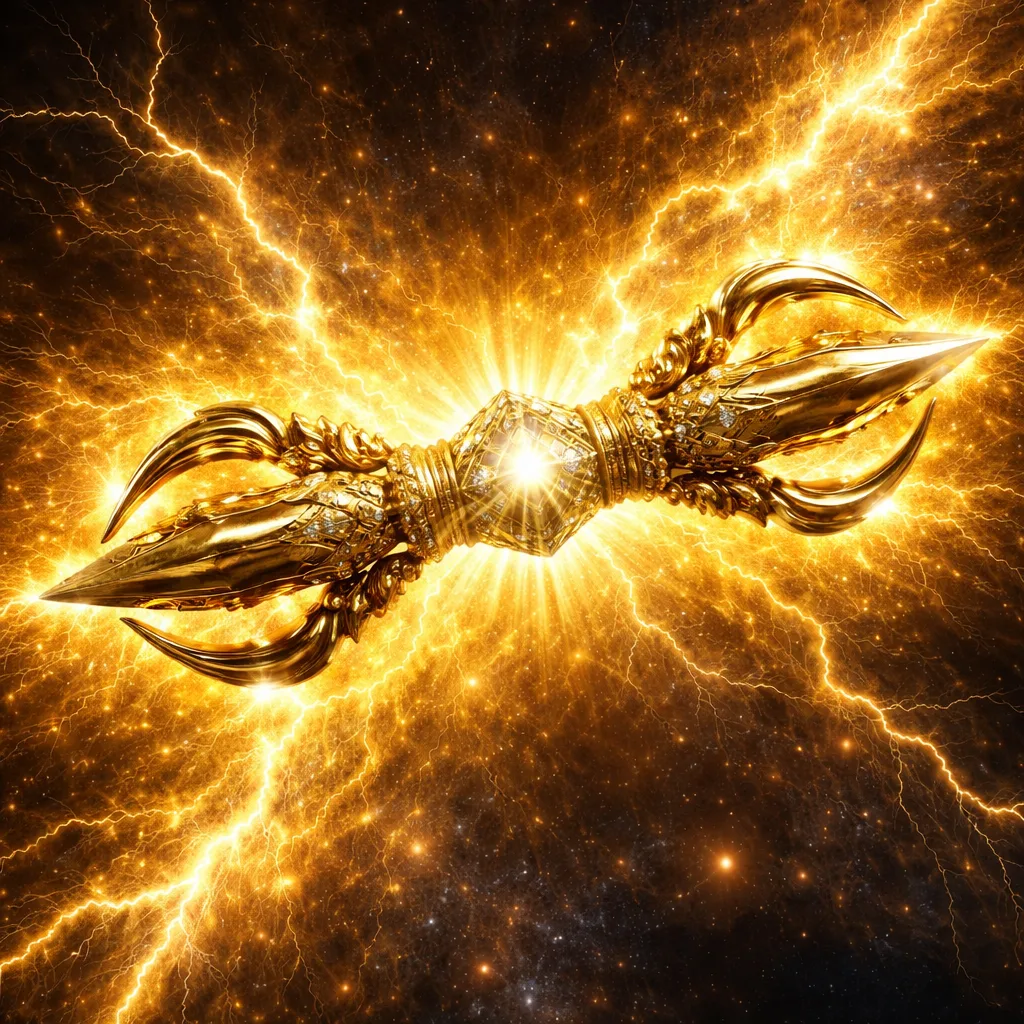
The story of the Vajra begins with an act of supreme sacrifice that remains one of the most moving tales in all Hindu mythology. The demon Vritra — an asura of incomprehensible power created by Vishwakarma on behalf of the demon king Tvashta — had conquered all three worlds. Indra, king of the gods, was humiliated and cast from Svarga. His thunderbolts were useless against Vritra's scales, which were impervious to all divine weapons forged from earthly or heavenly materials.

In desperation, the gods approached Lord Vishnu, who revealed a fateful solution: only a weapon made from the bones of the great sage Dadhichi could destroy Vritra. Dadhichi was a sage of incomparable tapasya (austerity) whose bones had become harder than diamond through decades of spiritual practice. When the gods approached him with their impossible request, Dadhichi did not hesitate. He sat in meditation, released his soul from his body, and his bones remained. His voluntary death for the welfare of the universe is considered one of the greatest acts of selfless sacrifice (daan) in all of scripture.

Vishwakarma fashioned the Vajra from Dadhichi's spine — a weapon that combined divine craftsmanship with the spiritual energy of a realized sage's entire lifetime of tapasya. When Indra returned to battle Vritra with the Vajra, the contest was extraordinary. The Rigveda devotes numerous hymns to this battle — considered the cosmic archetype of light overcoming darkness, rain defeating drought, the life-giving monsoon released from the clutches of demonic obstruction. When Indra finally struck Vritra with the Vajra, the demon was split apart, and the waters (held hostage in his body) flooded the earth — bringing rain and life to all creation.

The Vajra appears again in the story of Arjuna — who, in the Mahabharata, is revealed to be a partial incarnation of Indra. Indra disguised himself as a Brahmin to beg for Karna's divine armour (Kavacha-Kundala), weakening Karna before the war. In return, Karna received the Shakti — a one-time spear forged from the Vajra's essence — which he used to kill Ghatotkacha.

Generates thunderbolts powerful enough to split mountains
💎Indestructible — harder than diamond, made from spiritually charged bones
🌧️Associated with rain, fertility, cosmic order (Rta)
🛡️Also serves as a shield — Indra uses it defensively against asuras
📖 Rigveda 📖 Mahabharata 📖 Bhagavata Purana 📖 Matsya Purana
Weapon 05 · Astra · Nuclear-class Divine Missile
Brahmastra — Divine Missile 🌟

Brahmastra

ब्रह्मास्त्र — ब्रह्मा की सृष्टि शक्ति
🪷 Created by Lord Brahma (God of Creation)
Mahabharata Ramayana World-Ending Power
TypeAstra — invoked by mantra
EffectScorches all living beings in target zone
Known UsersDrona, Ashwatthama, Arjuna, Ram
CounterOnly another Brahmastra or supreme surrender

The Brahmastra is, in the understanding of modern scholars, a weapon that closely mirrors the concept of nuclear annihilation. When it strikes, everything within its target zone — plant, animal, human, and demon — is consumed. The land scorched by a Brahmastra becomes barren for twelve years. Rain does not fall. No child is born. The Brahmastra is not merely a weapon of war; it is the application of Brahma's creative force in reverse — creation's energy turned toward absolute annihilation.

Its most dramatic appearance in the Mahabharata comes in the war's final act. The warrior Ashwatthama — son of Drona, the greatest military teacher — was among the few survivors of the Kaurava side. Consumed by grief and fury at the death of Duryodhana, Ashwatthama executed a night raid on the Pandava camp, killing the five sons of Draupadi while they slept. When Arjuna and the Pandavas pursued him, Ashwatthama — knowing he could not defeat Arjuna in direct combat — invoked the Brahmastra against the entirety of the Pandava lineage, aiming it at the womb of Uttara, who was carrying Arjuna's unborn grandson Parikshit.

Arjuna responded by invoking his own Brahmastra. For a terrible moment, two Brahmastras faced each other in the sky — a collision that the rishis said would have destroyed the earth entirely. The sage Vyasa commanded both to be withdrawn. Arjuna — having the discipline of a true warrior — withdrew his Brahmastra. Ashwatthama, who had never properly learned to recall it, could not. He redirected it at Uttara's womb. Lord Krishna personally descended with his Sudarshan Chakra and surrounded Uttara's womb with divine protection, saving the unborn Parikshit. Ashwatthama was cursed to wander the earth for three thousand years, bearing a festering wound on his forehead — a punishment for his unethical use of the supreme weapon.

In the Ramayana, the Brahmastra was used by Lord Ram against the demon Maricha (the golden deer). When Ram shot Maricha, Maricha used his dying breath to imitate Ram's voice crying for help — a deception that would separate Ram from Sita and set the Ramayana's central tragedy in motion.

☢️Scorches everything in its path — land barren for 12 years after
🌊Can counter other divine missiles including its own kind
👁️Only warriors of exceptional purity and discipline can invoke it
🚫Once invoked, cannot be stopped except by another Brahmastra or the gods themselves
📖 Mahabharata 📖 Valmiki Ramayana 📖 Brahma Purana
Weapon 06 · Astra · Supreme Destroyer
Pashupatastra of Lord Shiva 🔥

Pashupatastra

पाशुपतास्त्र — महादेव का सर्वोच्च अस्त्र
🔱 Owned by Lord Shiva
Mahabharata Supreme Weapon Arjuna's Greatest
SanskritPashu (being) + Pati (lord) = Pashupati = Shiva
Gifted ToArjuna by Shiva personally
ConditionMust never be used against mortals
PowerCan end all creation if misused

Among all divine weapons described in Hindu scripture, the Pashupatastra stands in a category of its own — described as capable of destroying all creation if improperly used. It is the personal weapon of Lord Shiva in his aspect as Pashupati (Lord of all beings), and it was given to Arjuna directly by Shiva himself in one of the most remarkable encounters in the Mahabharata.

During the twelve years of forest exile before the Kurukshetra war, the sage Vyasa advised the Pandavas that they needed divine weapons to survive the coming conflict. Arjuna was chosen to undertake the quest. He performed severe austerities in the Himalayas for an extraordinary length of time, meditating without food or water, until his radiance threatened the comfort of the sages. Shiva decided to test him. He appeared in the form of a Kirata — a forest hunter — accompanied by his wife Parvati. A great boar (sent by the demon Muka, a spy of Duryodhana) attacked Arjuna, and both Arjuna and the Kirata shot it simultaneously.

A fierce argument erupted over who had killed the boar. Arjuna shot arrow after arrow at the Kirata — but all arrows disappeared. His bow was then shattered. Arjuna fought with his bare hands, then with his quiver, then with whatever he could grab — and was systematically and effortlessly defeated by this forest dweller. Completely humbled, Arjuna offered a garland of forest flowers to an earthen image of Shiva as a final prayer. The garland rose into the air — and settled on the Kirata's head. Shiva revealed his divine form, glowing with the radiance of a thousand suns, and was deeply pleased by Arjuna's fighting spirit and ultimate surrender.

Shiva reached into the air and drew out the Pashupatastra — a weapon that takes any form the wielder commands: it can be a disc, a missile, a mace, or pure energy. He placed it in Arjuna's hands with a solemn instruction: this weapon must never be used against a mortal opponent, only against supernatural enemies of incomparable power. The misuse of the Pashupatastra would destroy the three worlds themselves. Arjuna kept this oath throughout the war, never invoking it despite terrible provocation.

🌋Can destroy the entire universe if used without just cause
🔄Takes any form — disc, missile, mace, or pure blazing fire
🚫Prohibited from use against ordinary mortals — only supreme supernatural opponents
💫Embodies Shiva's Pralaya (cosmic dissolution) energy directly
🧘Can only be obtained through surrender to Shiva — not force or cleverness
📖 Mahabharata (Vana Parva) 📖 Shiva Purana 📖 Kishkindha Kanda
Weapon 07 · Astra · Unstoppable Divine Shower
Narayanastra of Lord Vishnu 🌀

Narayanastra

नारायणास्त्र — विष्णु का अजेय अस्त्र
🦚 Owned by Lord Vishnu / Narayana
MahabharataUnstoppable

The Narayanastra is unique among all divine weapons because it possesses one extraordinary and paradoxical property: the harder you fight it, the more powerful it becomes. This weapon was Vishnu's personal missile — an astra that, once released, produces an infinite shower of blazing arrows, flaming maces, discs, and spears. No weapon in creation can counteract it. No shield can block it. The only way to survive the Narayanastra is through complete, unconditional surrender — laying down all weapons, dismounting from one's vehicle, and prostrating face-down in total submission.

In the Mahabharata, the Narayanastra was known to Drona's son Ashwatthama, who had inherited it from his father. On the 15th day of the Kurukshetra war, after Drona's death, Ashwatthama invoked the Narayanastra against the entire Pandava army in his grief and rage. The sky darkened and rained millions of divine projectiles simultaneously. The Pandava warriors who tried to fight back found the weapon intensifying further. Only Krishna understood the counter. He commanded every soldier to drop their weapons and prostrate themselves on the ground in an act of total surrender to Vishnu. Those who obeyed survived. One warrior — Bhima — refused, his pride insurmountable. Krishna physically wrestled him to the ground and forced him into the surrender position, saving his life.

This story is rich with spiritual teaching: the greatest power is sometimes conquered not by greater power, but by surrender. The ego's resistance to submission is the most dangerous battle of all.

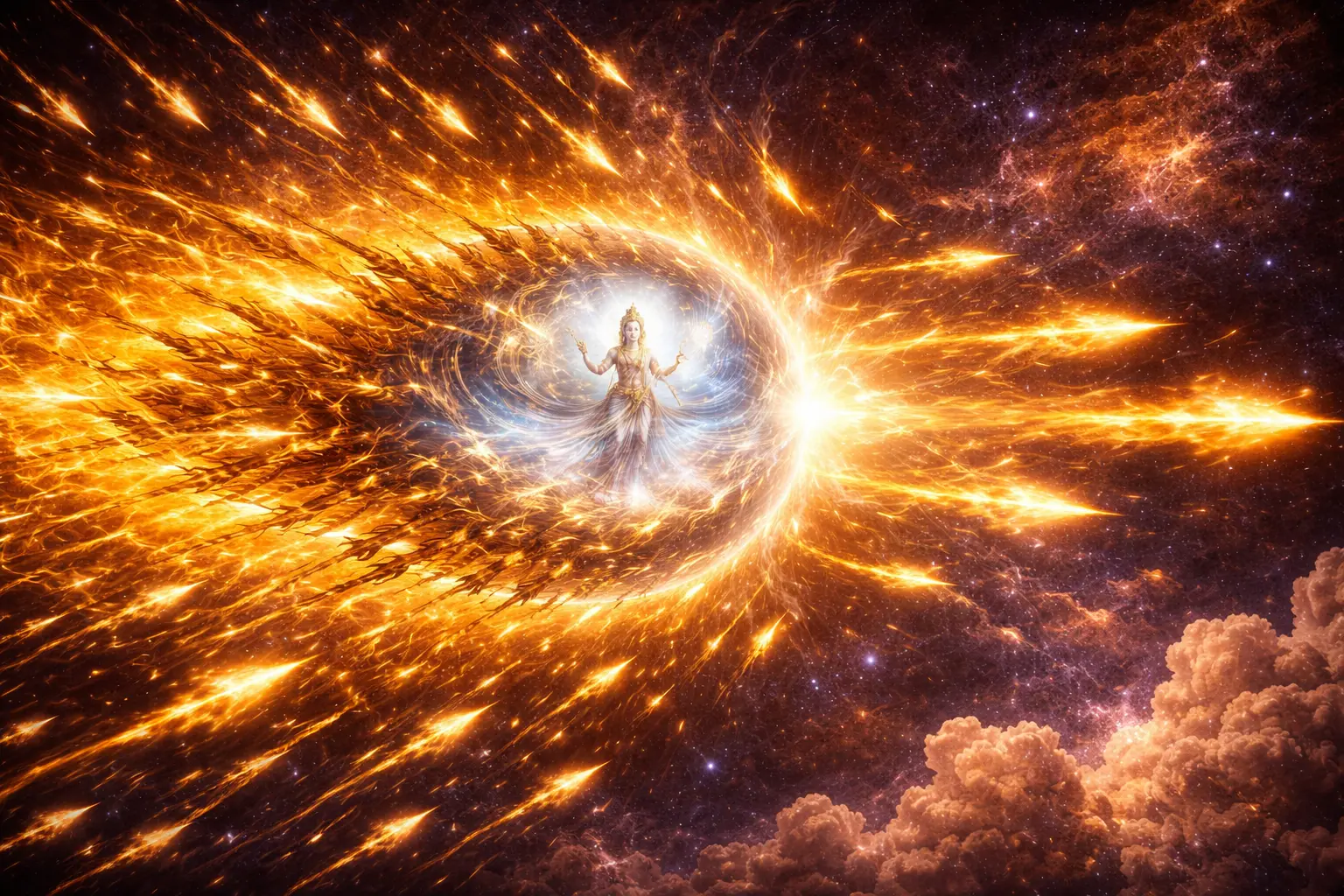
🌊Rains millions of divine projectiles simultaneously — an unstoppable storm
📈Grows more powerful the more one resists it — uniquely paradoxical weapon
🙏Counter: complete, unconditional surrender to Vishnu
🔁Can only be used once by a warrior in a battle
📖 Mahabharata (Drona Parva)📖 Vishnu Purana
Weapon 08 · Astra · Fire Missile
Agneyastra — Fire Missile 🔥

Agneyastra

अग्न्यास्त्र — अग्निदेव का अस्त्र
🔥 Presided by Agni (God of Fire)
RamayanaMahabharataFire Weapon

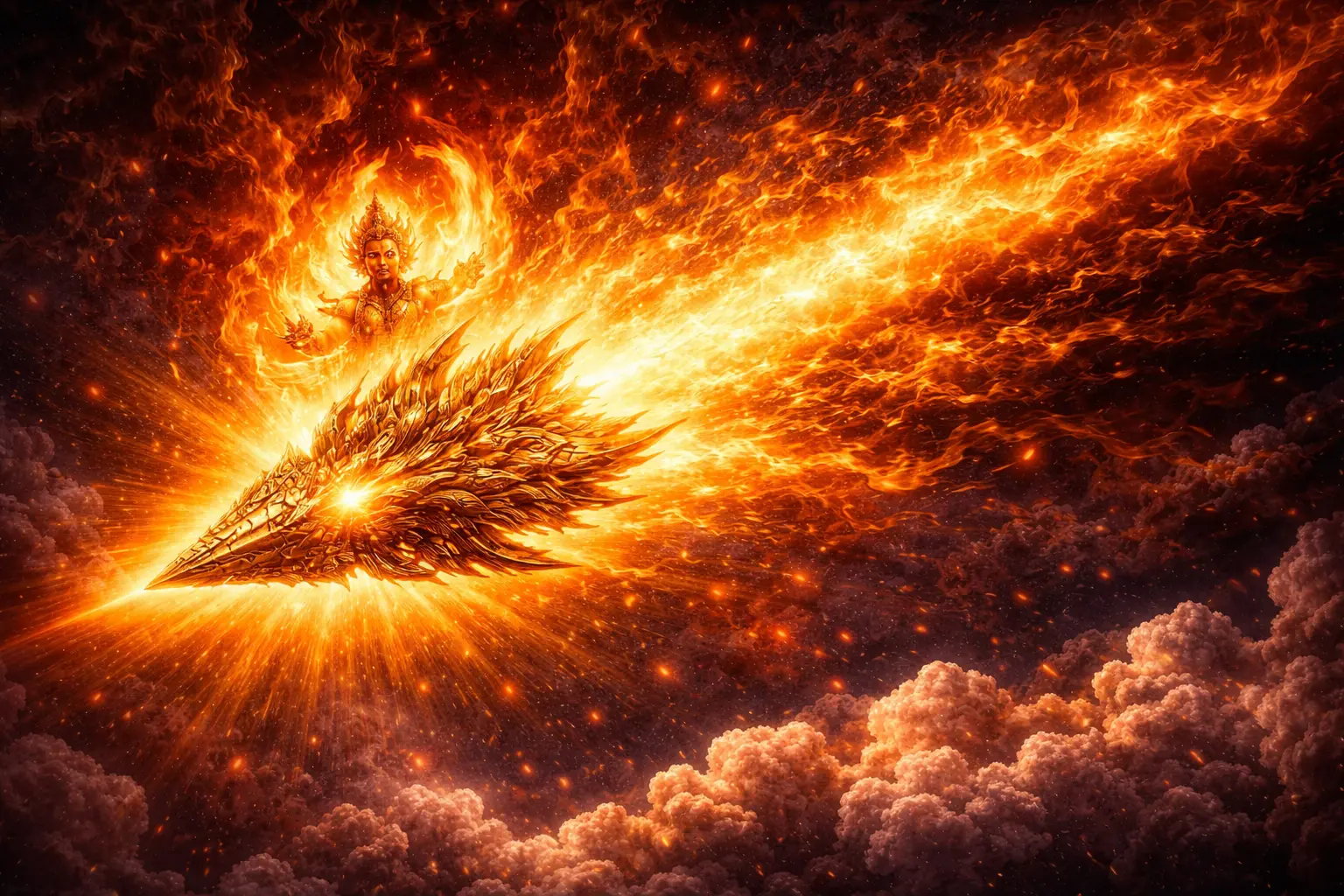
The Agneyastra is an astra presided over by Agni, the Vedic god of sacred fire — the divine flame that consumes offerings, carries prayers to the gods, and serves as the witness to all sacred rites. When invoked, the Agneyastra releases a torrent of supernatural fire that cannot be extinguished by water, wind, or earth. It can only be countered by its cosmic opposite: the Varunastra (water weapon).

In the Ramayana, when Lord Ram fought the demon king Ravana's forces at Lanka, the Agneyastra was used multiple times in the devastating aerial battles. Ram's ally Vibhishana — Ravana's righteous younger brother — provided tactical knowledge, but it was the divine arsenal of both sides that defined the conflict's scale. Ravana's generals were no ordinary demons — many possessed divine weapons gifted from years of tapasya, and the Agneyastra was among those deployed in the great aerial wars above Lanka.

The Agneyastra also appears prominently in the Mahabharata during the battle between Drona's students. Arjuna, having mastered it from Drona, used it to counter fire-based attacks from Kaurava warriors. The counter-weapon, Varunastra (presided by Varuna, god of oceans), creates a deluge to extinguish the Agneyastra's flames — demonstrating how ancient Hindu thought understood elemental balance and cosmic opposition as weapons systems.

🔥Supernatural fire impervious to normal water — burns even in rain
🌊Counter: Varunastra — only the god of water's weapon can extinguish it
💨Wind-based weapons (Vayavastra) can intensify it to uncontrollable levels
📖 Valmiki Ramayana📖 Mahabharata📖 Agni Purana
Weapon 09 · Astra · Water Missile
Varunastra — Water Missile 🌊

Varunastra

वारुणास्त्र — वरुण देव का जल अस्त्र
🌊 Presided by Varuna (God of Cosmic Waters)
RamayanaWater WeaponElemental

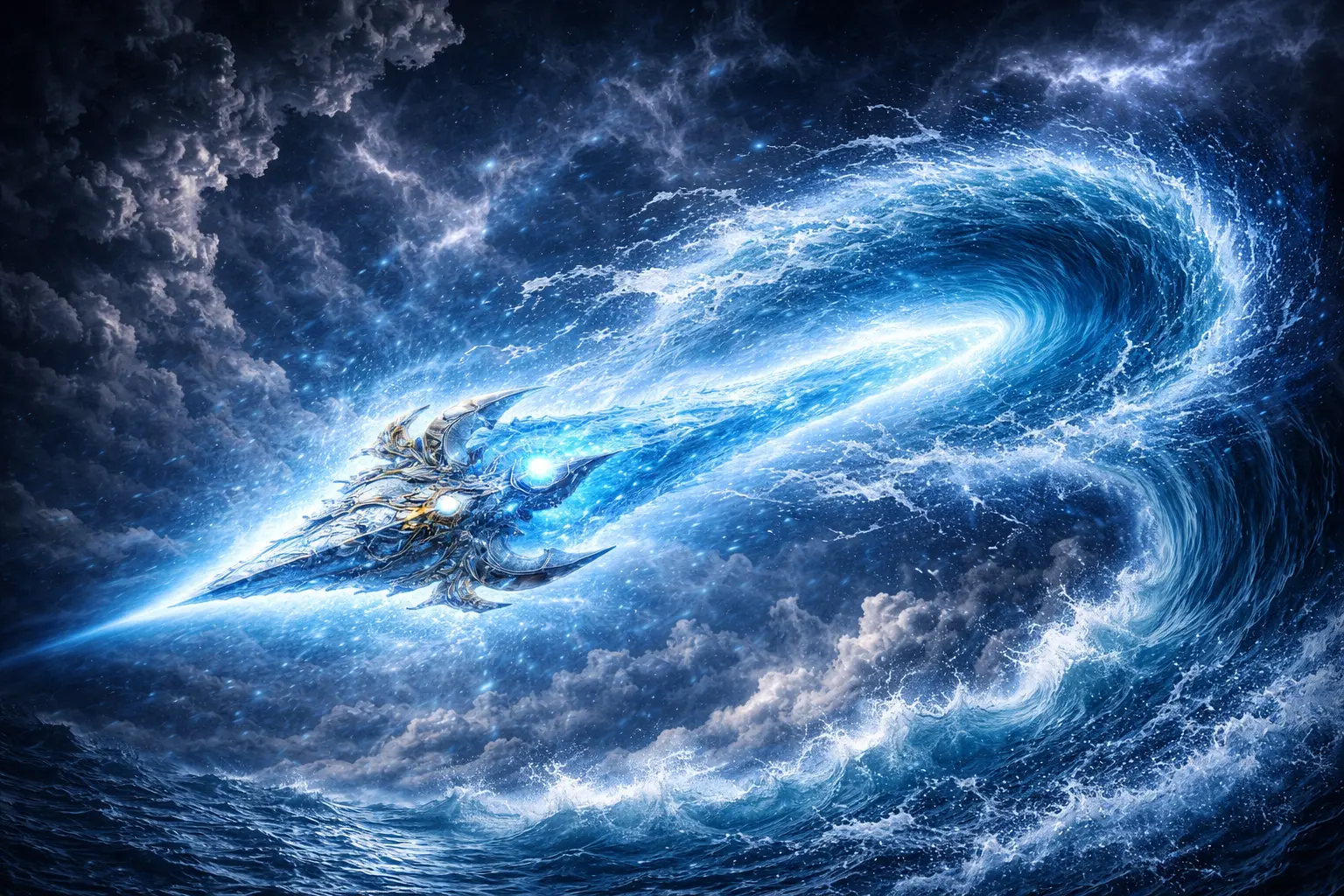
Varuna, in the Vedic tradition, is among the oldest and most cosmic of deities — the lord of the primordial waters (Apas), the enforcer of cosmic law (Rta), and the keeper of the celestial noose (Pasha) that binds sinners. His Varunastra unleashes the power of all waters simultaneously — floods, tsunamis, supernatural downpours, and whirlpools of cosmic scale. Where the Agneyastra burns, the Varunastra drowns and suffocates flames.

The most celebrated use of the Varunastra occurs in the Ramayana's war at Lanka. When the demon commander Indrajit (Ravana's son Meghnaad) — who had conquered Indra himself — unleashed Nagapasha (serpent bonds) to bind Ram and Lakshmana, it was Garuda who freed them. But when fire-based Astras ravaged the monkey army, the Varunastra was invoked as a countermeasure. Lord Hanuman — who could travel at the speed of thought — played a crucial role in coordinating these cosmic weapon counterattacks.

The Varunastra also appears in the Mahabharata when Arjuna, trained in all elemental weapons by Drona and Indra, used it in battle situations requiring precision dousing of fire-based attacks. The weapon creates not just water but the divine force of Varuna's noose — binding, dissolving, and overwhelming simultaneously. Together, the Agneyastra and Varunastra represent the Hindu understanding of elemental balance: fire and water as the fundamental creative-destructive pair.

🌊Produces floods capable of drowning entire armies instantly
🔥Counter to Agneyastra — the only weapon that extinguishes divine fire
🪢Can also act as a binding weapon — trapping foes in whirlpools
📖 Valmiki Ramayana📖 Mahabharata📖 Varuna Sukta (Rigveda)
Weapon 10 · Astra · Eagle Weapon
Garudastra — Garuda Missile 🦅

Garudastra

गरुड़ास्त्र — गरुड़ का दिव्य अस्त्र
🦅 Presided by Garuda (Vishnu's Eagle Mount)
RamayanaAnti-SerpentLiberation Weapon

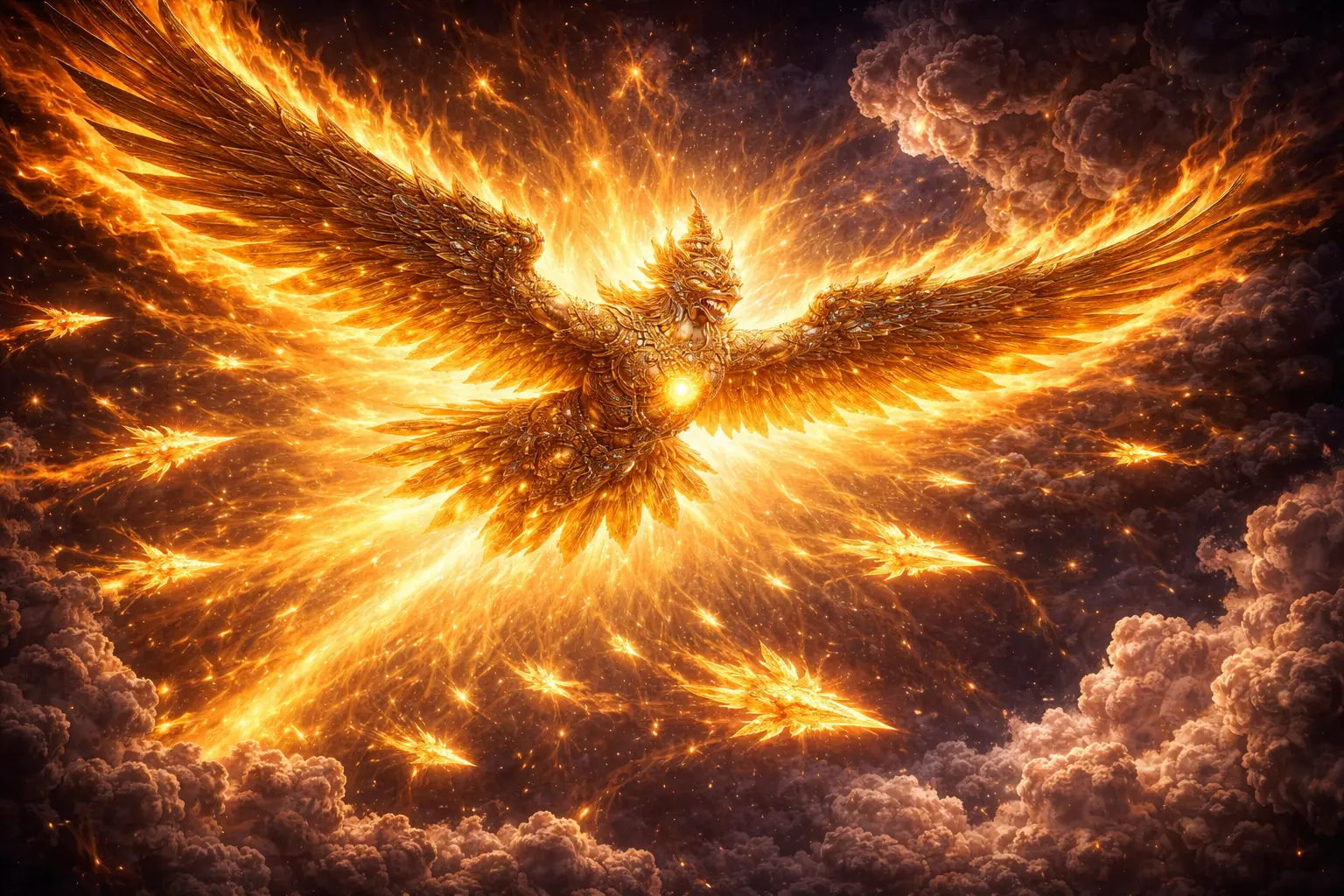
Garuda — the divine eagle and mount of Lord Vishnu — is the eternal enemy of serpents (Nagas). This cosmic enmity traces to the birth of the universe: Garuda's mother Vinata and the serpent mother Kadru were sisters whose rivalry led to Garuda's eternal hatred of nagas. Because of this cosmic relationship, the Garudastra is particularly effective against all serpent-based weapons, including the devastating Nagapasha astra.

The Garudastra's most celebrated moment in mythology is one of pure rescue — and its arrival marks one of the most poignant scenes in the Valmiki Ramayana. During the war at Lanka, the demon commander Indrajit — Ravana's brilliant, invincible son — used the Nagapasha astra against Ram and Lakshmana. Thousands of venomous serpents wrapped themselves around both divine brothers, binding them completely. The monkey army was in despair, believing their divine commanders dead. The entire future of dharma hung in the balance.

At that moment, the sky darkened with wings. Garuda himself — not an astra but the divine being — descended from Vishnu's realm, his golden wings creating hurricane-force winds that scattered Lanka's armies. The serpent bindings dissolved instantly in Garuda's presence — as snakes flee in terror before their eternal predator. He touched Ram and Lakshmana with his wings, healing all wounds and restoring them to full strength. This single intervention was enough: Garuda's arrival confirmed to the demon armies that they faced not merely a human prince but the avatar of Vishnu himself. The Garudastra, by contrast, invokes Garuda's energy as a directed weapon — unleashing divine light and eagle-force that dissolves serpent-based attacks and brings liberation (Garuda being associated with moksha in Vaishnavism).

🦅Supreme counter to all serpent-based weapons (Nagapasha etc.)
💨Creates divine wind that disperses and destroys snake formations
🌟Associated with moksha — liberation is implicit in Garuda's presence
📖 Valmiki Ramayana📖 Garuda Purana📖 Mahabharata
Weapon 11 · Shastra · Divine Sword
Nandaka Sword of Lord Vishnu ⚔️

Nandaka

नन्दक — विष्णु की तलवार
🦚 Owned by Lord Vishnu
Vishnu PuranaSword of KnowledgeShastra

Among Vishnu's four primary weapons — the Sudarshan Chakra, Sharanga bow, Kaumodaki mace, and Nandaka sword — the Nandaka is the most philosophically rich. Its name means "that which brings joy" or "the blissful one." But its esoteric meaning is far deeper: in the Vishnu Purana, the Nandaka sword is described as the embodiment of Jnana (divine knowledge) itself. Its blade is knowledge; its hilt is ignorance. When Vishnu draws the Nandaka, he is wielding the sword of wisdom that cuts through the darkness of cosmic ignorance (avidya).

The Devi Bhagavata recounts that the Nandaka was actually a divine being — a sura (lesser god) — who had been cursed to take the form of a sword as punishment for some transgression. The sword's quality of bringing liberation (rather than just death) to those it strikes reflects this divine consciousness within the blade itself.

In depictions of Vishnu in his ten avatars (Dashavatara), the Nandaka appears most prominently in his Kalki avatar — the tenth and final avatar yet to come, who will ride a white horse and use the Nandaka sword to restore dharma at the end of the Kali Yuga. The Kalki Purana describes Kalki dismounting from his horse Devadatta and using the Nandaka to systematically end the reign of adharma (unrighteousness) that will have engulfed the world. The sword, as cosmic knowledge, will literally cut through the world's spiritual blindness.

💡Embodies divine Jnana — the sword of cosmic knowledge
⚔️Grants liberation to those it slays — death by Nandaka is moksha
🌅Primary weapon of Kalki avatar — will restore dharma at Kali Yuga's end
📖 Vishnu Purana📖 Devi Bhagavata📖 Kalki Purana
Weapon 12 · Shastra · Vishnu's Bow
Sharanga — Vishnu's Bow 🏹

Sharanga

शार्ङ्ग — विष्णु का दिव्य धनुष
🦚 Owned by Lord Vishnu / Krishna
HarivamsaVishnu's ArsenalDivine Bow

The Sharanga is Vishnu's personal bow — the counterpart to Shiva's Pinaka. Where the Pinaka embodies Shiva's destructive power, the Sharanga embodies Vishnu's preserving force. The two bows are considered cosmic opposites and cosmic equals — a pairing that is explicitly acknowledged in the Devi Bhagavata when it is stated that in a direct confrontation between Brahma's creation, Shiva's destruction, and Vishnu's preservation, none would be superior. Their weapons would cancel each other out.

An extraordinary story in the Harivamsa — the appendix to the Mahabharata — records a direct confrontation between Shiva and Krishna over the Sharanga. When the great sage Durvasa cursed a king, Vishnu's devotee Ambarisha sought Krishna's protection. This drew Shiva's attention, who came to establish the primacy of his own power. A battle between Shiva and Krishna commenced — one of the rarest events in all Puranic literature. Both were equally matched. The battle ended not in victory but in mutual recognition: Shiva acknowledged Vishnu's preserving nature and Krishna acknowledged Shiva's sovereignty over dissolution. The Sharanga and Trishul were lowered in mutual respect.

The Sharanga bow appears in Vishnu's hands in virtually every form of divine iconography — present in the hands of all his ten avatars, from Rama (who also received Vishnu's Sharanga via Parashurama) to Krishna. When Parashurama — the sixth avatar — confronted Ram after the breaking of Pinaka, he presented the Sharanga as the ultimate test. Could Ram string Vishnu's own bow? Ram did so effortlessly, confirming that Ram was himself Vishnu, and Parashurama's cosmic purpose was complete.

🏹Cosmic equal of Shiva's Pinaka — neither can overcome the other
Present in all Vishnu avatars — divine continuity across cosmic cycles
🌐Its string when plucked produces the AUM sound that sustains all creation
📖 Harivamsa📖 Valmiki Ramayana📖 Vishnu Purana
Weapon 13 · Shastra · Arjuna's Sacred Bow
Gandiva — Arjuna's Divine Bow 🏹

Gandiva

गाण्डीव — अर्जुन का दिव्य धनुष
⚡ Given to Arjuna (son of Indra)
MahabharataArjuna's WeaponBrahma's Creation
OriginCreated by Brahma, passed through deities
SpecialComes with 2 inexhaustible quivers
DurationArjuna used it for 65 years
After WarReturned to Agni (fire god)

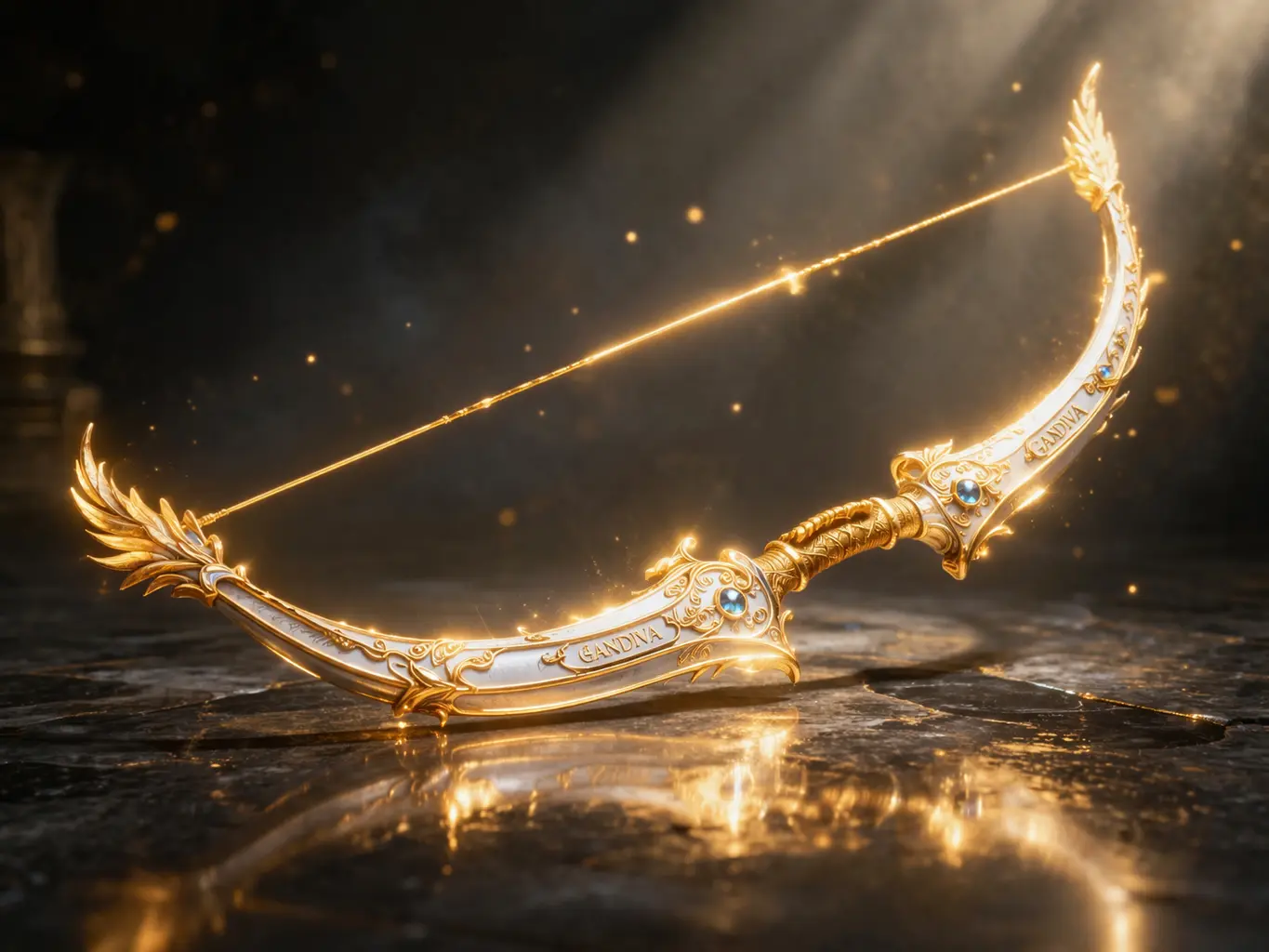
The Gandiva's provenance spans the entire cosmic order. Brahma created it and wielded it for a thousand years. It then passed to Prajapati for five hundred years, then to Indra for five hundred and eighty years, then to the Moon god Soma for five hundred years, and finally to Varuna — god of the cosmic waters — in whose watery realm it resided. It was from Varuna that Agni (fire god) requested the Gandiva when he sought to consume the Khandava Forest — Indra's protected reserve — with Arjuna and Krishna as his divine assistants.

Arjuna, fighting alongside Krishna to help Agni consume the Khandava Forest, displayed such extraordinary archery that Agni was satisfied — and Varuna presented the Gandiva to Arjuna as a gift worthy of the occasion. The bow came with two inexhaustible quivers: no matter how many arrows Arjuna fired, the quivers would never empty. Together, these three — Gandiva, the inexhaustible quivers, and Krishna's guidance — made Arjuna the supreme archer of his age.

The Gandiva's sound when its string was plucked was likened to thunder — a sound that could terrify elephant armies and shatter the morale of opposing forces before a single arrow was fired. Throughout the eighteen days of the Kurukshetra war, the Gandiva was Arjuna's primary weapon. Its hundred thousand simultaneous arrows in a single draw (as described in the Bhishma Parva) made Arjuna effectively invincible against conventional opponents. After the war, when the Pandavas began their final journey, Agni appeared to reclaim the Gandiva and the inexhaustible quivers. Arjuna cast both into the ocean — completing a cosmic loan that had lasted sixty-five years.

🏹Can fire 100,000 arrows in a single draw — each perfectly aimed
♾️Accompanied by two inexhaustible quivers — unlimited arrows in battle
🌩️Its bowstring sound alone causes elephants to flee and warriors to falter
👑Passed through Brahma, Indra, Moon, Varuna before reaching Arjuna
📖 Mahabharata (Adi Parva)📖 Bhishma Parva📖 Svargarohana Parva
Weapon 14 · Shastra · Divine Mace
Kaumodaki Mace of Lord Vishnu 🪃

Kaumodaki

कौमोदकी — विष्णु की गदा
🦚 Owned by Lord Vishnu / Krishna
Vishnu PuranaMace of TimeVaruna's Gift

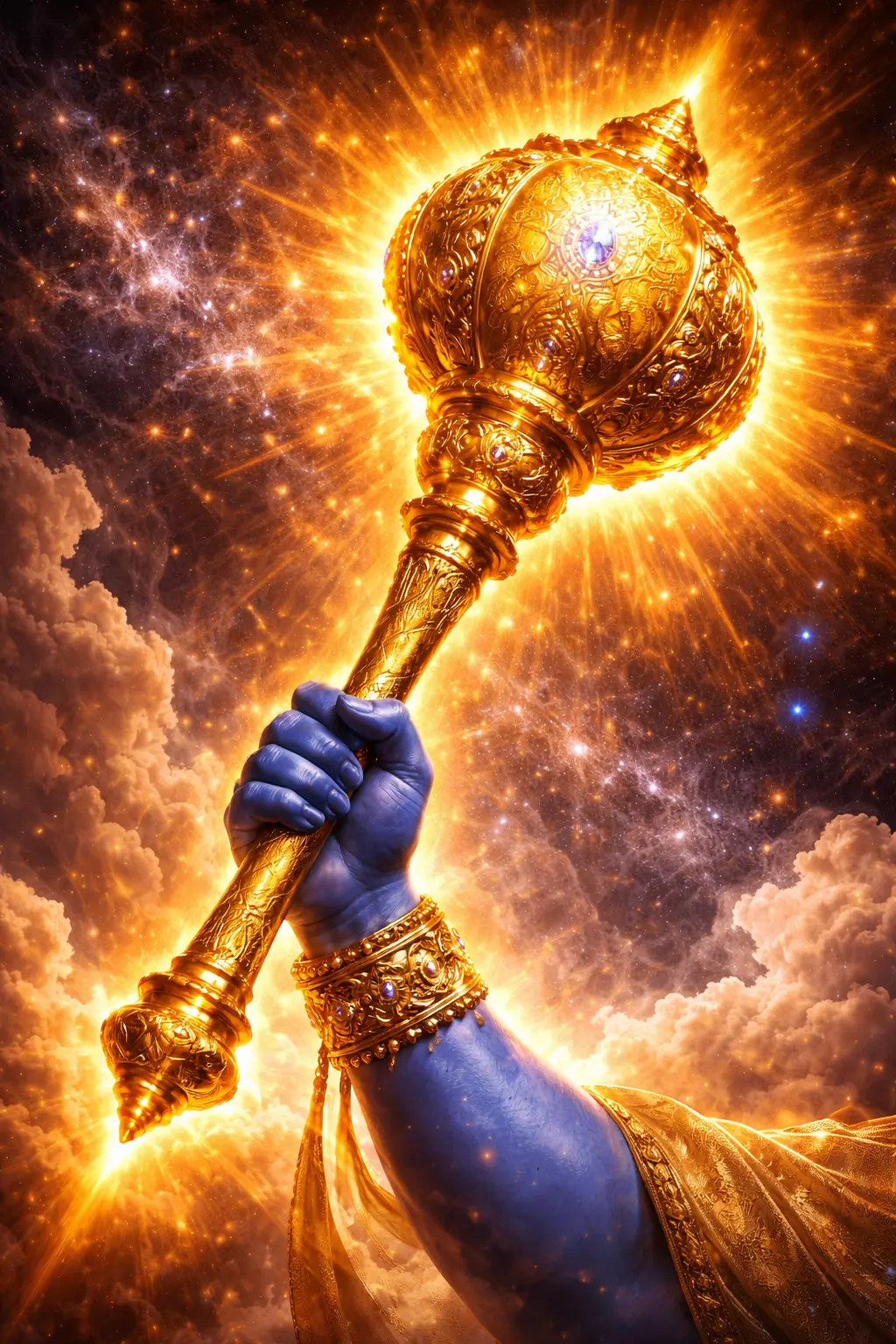
The Kaumodaki is Vishnu's mace — a weapon of overwhelming physical and cosmic force. Its name is derived from the word kumuda (a lotus that blooms at night, associated with the moon and the cooling effect of divine grace). Like all of Vishnu's four weapons, the Kaumodaki is not merely physical — it is associated with a cosmic principle. The Kaumodaki represents the power of time (Kala) — the force that ultimately overcomes all beings. Even the mightiest demon cannot escape the inexorable swing of time.

According to the Vishnu Purana, the Kaumodaki was originally in the possession of Varuna, god of cosmic waters, who presented it to Vishnu. The mace shines like sunlight, and its very touch is said to bring liberation. In artistic depictions, Vishnu holds it in his lower right hand — the hand of active action — alongside the Sudarshan Chakra in his upper right hand, the conch Panchajanya in his upper left, and the lotus in his lower left.

In his avatar as Krishna, the Kaumodaki appears in the extraordinary episode of the battle against the demon Naraka (Narakasura). Naraka had conquered the three worlds, imprisoned 16,100 women stolen from the gods, and held Indra's mother captive. When Krishna and his wife Satyabhama rode to battle on Garuda, it was Krishna who primarily wielded the Sudarshan Chakra while Satyabhama — fulfilling her role as Bhumidevi (Earth goddess) avenging her demon son — struck the killing blow. The Kaumodaki's presence throughout this battle served as the anchor of Krishna's four-weapon arsenal. After Naraka was slain, Krishna married all 16,100 freed women — a symbolic act of restoring honor to those unjustly imprisoned.

In the Hanuman tradition, the Kaumodaki appears in a surprising story: when the sage Durvasa's curse threatened to destroy Yudhishthira, and Hanuman volunteered to delay Durvasa by challenging him — Vishnu himself appeared with the Kaumodaki to protect his great devotee Hanuman.

Embodies Kala (divine time) — no being can escape its cosmic swing
🌟Shines like the sun — its radiance alone blinds demonic forces
🙏Its touch grants liberation — dying by Kaumodaki is considered auspicious
🌊Originally gifted by Varuna — carries ocean-depth force behind each blow
📖 Vishnu Purana📖 Bhagavata Purana📖 Harivamsa
🕉️
Deeper Meaning

What Divine Weapons Symbolise

⚖️
Dharma as Weaponry

Every divine weapon in Hindu mythology is dharma made manifest — the cosmic principle of righteousness expressed as force. They cannot be misused without severe karmic consequence, as Ashwatthama's eternal punishment demonstrates.

🧘
Surrender Over Strength

The Narayanastra's paradox — defeated by surrender, not strength — encodes one of Hinduism's deepest teachings. Divine weapons ultimately test character, not physical power.

⚗️
Elemental Balance

Fire (Agneyastra) and water (Varunastra) as counter-weapons reflect the Hindu cosmological understanding of elemental pairs — creation and dissolution always in dynamic balance.

💎
Sacrifice Empowers

The Vajra — made from Dadhichi's bones — teaches that genuine sacrifice transforms into divine power. What is freely given becomes indestructible. The greatest weapons come from the greatest generosity.

Frequently Asked Questions

Divine Weapons — FAQs

What is the most powerful weapon in Hindu mythology?
The Brahmastra, Pashupatastra, and Narayanastra are considered the three most destructive weapons. The Pashupatastra — gifted by Lord Shiva to Arjuna — is most often cited as the supreme weapon, capable of annihilating all creation. Its use is so catastrophically dangerous that Arjuna never fired it despite having it for the entire Mahabharata war. The Brahmastra, created from Brahma's energy, can destroy entire worlds and render land barren for twelve years. The Narayanastra is unstoppable to all except those who completely surrender to Vishnu.
What is the difference between Astra and Shastra in Hindu mythology?
An Astra is a supernatural projectile weapon invoked through a mantra — it is launched mentally or with a special chant, imbued with divine energy (like Brahmastra or Pashupatastra). A Shastra is a physical weapon wielded directly by hand — like a sword, mace, or trident. Both categories appear throughout the Ramayana and Mahabharata. The key difference: Astras are energy-based missiles, while Shastras are physical weapons of divine craftsmanship.
Who can use the Brahmastra?
The Brahmastra can only be invoked by those who have received its initiation (diksha) from a qualified guru and have undergone years of disciplined practice. In the epics, warriors like Drona, Ashwatthama, Parashurama, and Arjuna knew it. There is a strict moral component: the Brahmastra must only be used as a last resort against a supreme supernatural opponent. Ashwatthama's unauthorized use against an unborn child is presented as the gravest possible violation — his punishment was eternal exile bearing a festering wound.
What happened to Arjuna's Gandiva bow after the Mahabharata war?
After the Mahabharata war ended, Agni — the fire god who had originally gifted the bow — appeared to Arjuna and requested its return. The Gandiva was a divine loan, not a permanent gift. Arjuna cast both the Gandiva and the two inexhaustible quivers into the ocean. The Gandiva was said to have been fashioned with supernatural materials and passed through Brahma, Indra, the Moon god, and Varuna before reaching Arjuna. Its cosmic journey complete, it returned to the divine realm from which it came.
Is the Sudarshan Chakra the same as the chakra used by Krishna?
Yes. The Sudarshan Chakra belongs to Lord Vishnu and is carried by Lord Krishna as his avatar. It is described as a spinning disc of blazing light with 108 serrated edges that spins on the tip of Vishnu's right index finger. While Vishnu wields it constantly across all ages, Krishna famously used it to create an artificial eclipse on the 14th day of the Kurukshetra war — allowing Arjuna to kill Jayadratha before the real sunset and thereby preserve Arjuna's vow. Krishna also threatened to break his own vow of non-fighting and use the Sudarshan Chakra against Bhishma on the 9th day of the war, moved by Arjuna's desperate situation.